
Product Overview
Anodized aluminum panels are made by placing aluminum sheets in corresponding electrolytes (such as sulfuric acid, chromic acid, oxalic acid, etc.) as the anode, and performing electrolysis under specific conditions and an applied current, forming a dense oxide film on the surface of the aluminum plate. This oxide film mainly consists of Al₂O₃ and Al(OH)₃, with a thickness generally between 5~25μm.The anodizing process differs from ordinary painting processes—it uses electric current to electrolyze a conductive acidic electrolyte, causing oxidation of the aluminum metal surface that forms the anode, naturally forming a thick and dense protective film on the aluminum surface. This oxide film is not an additional coating but is integrated with the aluminum matrix and does not peel off. The oxide film is transparent and colorless, with a microcrystalline structure that is hexagonal honeycomb-shaped. It can use the natural color of aluminum to highlight a strong metallic feel, and evenly color the micropores to give the curtain wall rich colors.
Core Advantage
1. Ultra-High Hardness, Wear-Resistant and Scratch-Resistant
After anodizing, the surface hardness of aluminum panels can reach gemstone-grade quality, with excellent scratch resistance. The hard anodized film has a melting point as high as 2320K, with a surface unpainted, fully preserving the natural metallic color of the aluminum plate and highlighting a modern metallic feel.
2. Outstanding Weather Resistance and Ultra-Long Service Life
The anodized film has extremely strong corrosion resistance, able to withstand thousands of hours without corrosion in a salt spray environment of ω=0.03NaCl. Anodized aluminum panels with a standard thickness oxide film (3μm) will not discolor, corrode, oxidize, or rust indoors for a long time; Products with thickened oxide film (10μm) can be used directly outdoors and remain discolored under long-term sunlight exposure.
3. Pure Metallic Texture, Non-Flammable And Fire-Resistant
The surface is unpainted, retaining the natural metallic color of the aluminum plate with a strong metallic feel. Pure metal products, do not burn at 600°C and do not produce toxic gases, meeting fire safety and environmental protection requirements. It also has excellent insulation performance, with breakdown resistance up to 2000V.
4. Stain-Resistant and Easy to Clean, Leaving No Fingerprints
The anodized aluminum panel surface is less likely to develop corrosion spots, leaving no fingerprints or stains, making it easy to clean and easy to maintain.
5. Lightweight, High-Strength, and Excellent Workability
Anodized aluminum veneers have strong decorative properties and moderate hardness, allowing for easy bending and forming for continuous high-speed stamping. It is convenient to process directly into products without complex surface treatment, greatly shortening the production cycle and reducing production costs. Product thickness ranges from 0.3~50mm, with materials ranging from Series 1 to Series 6 aluminum alloy.
Product Classification & Selection Guide
1.Production Process
Anodized aluminum panels use a strict process flow:
Shelving→ degreasing → washed → alkaline etching → washed → neutralized→ washed → anodizing→ washed → sealing → washed → shelving→ inspection → packaging
During the pretreatment stage, processes such as degreasing, alkali etching, and pickling are used to remove grease and impurities from the aluminum panel surface, ensuring uniformity in subsequent treatment. The anodizing stage takes place in the electrolytic cell, forming an oxide film on the surface of the aluminum plate. The sealing and coloring processes provide products with rich color options and lock in surface performance.
Currently, there are mainly two production models in the industry:
- Traditional profile anodizing: Hanging production mainly for single sheets, highly flexible, suitable for small-batch production
- Continuous anodizing of coils: continuous processing of coils, highly automated, and precise color difference control, suitable for products with high color difference requirements
2.Product Series and Specifications
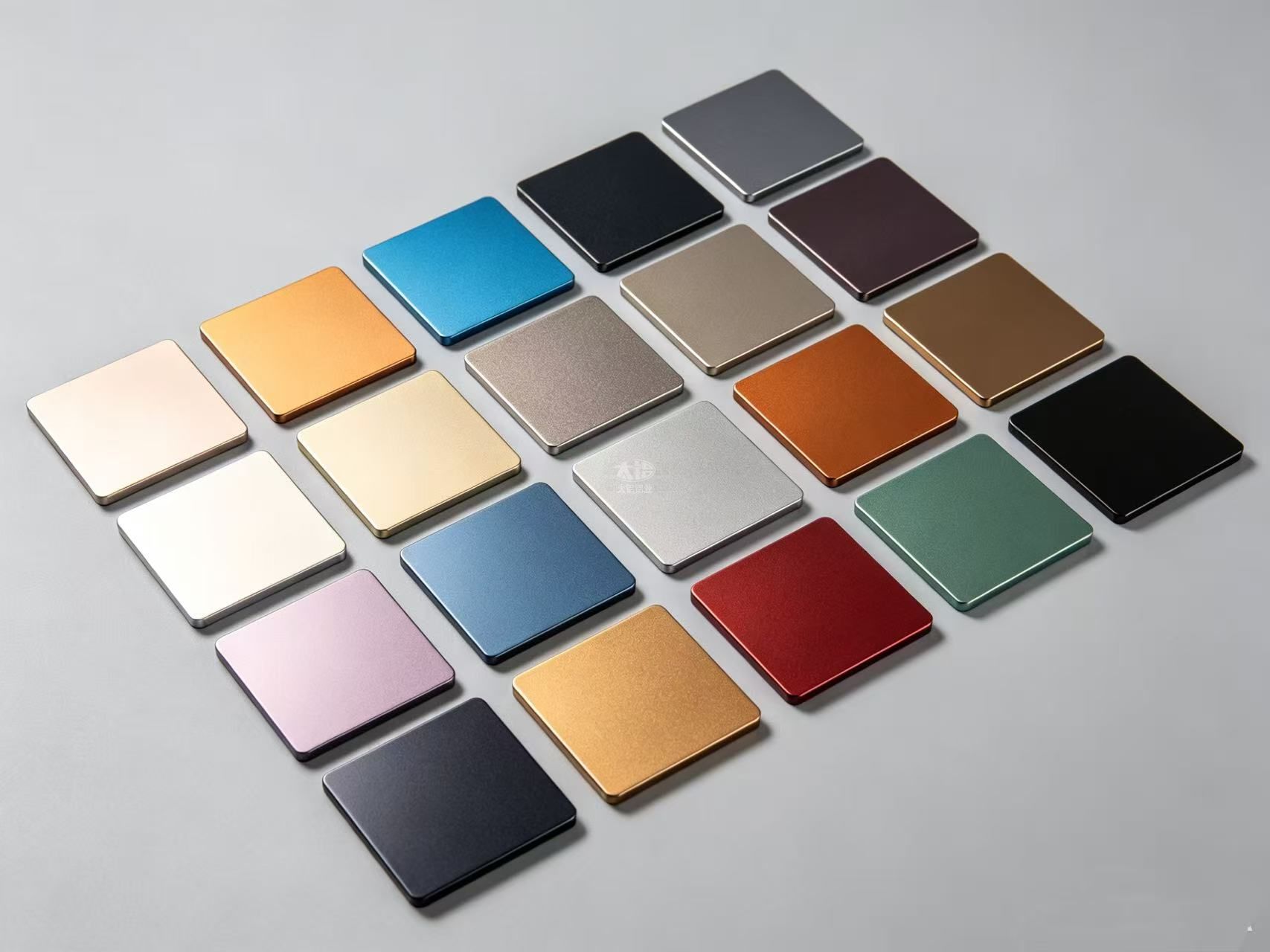
The anodized aluminum veneer product range is diverse, including brushed series, titanium silver series, mirror series, sanded finish, Embossed series, natural color, and colored series.
Common specifications:
- Thickness: 0.4mm ~ 5.0mm
- Material: 1100/1060, 3003, 5005, 6061 and other aluminum alloys
- Oxide film thickness: 5~25μm (standard), hard anodized film can reach 60~200μm
The products support flat, curved, and irregular customization to meet diverse design needs.
6.Application Scenarios
Anodized aluminum panels are widely used in various scenarios:
- Building curtain walls: exterior wall systems for administrative office buildings, commercial complexes, and office buildings
- Public buildings: airports, subway stations, exhibition halls, conference centers
- Interior decoration: hotel lobbies, elevator decorations, ceiling systems
- Commercial spaces: shopping centers, commercial buildings
- Industrial fields: electrical panels, cabinet panels, furniture panels, mechanical equipment housings
- Others: lighting fixtures, electronic consumer goods, handicrafts, signage, automotive decoration, etc
Anodized aluminum panels in building facades combine the advantages of "original metal aesthetics + long-term protection performance + environmentally friendly sustainability," making them the preferred material for modern architecture pursuing minimalism, durability, and green design. In recent years, its application has expanded from partial decoration to entire building facade systems, with market demand continuously rising.