
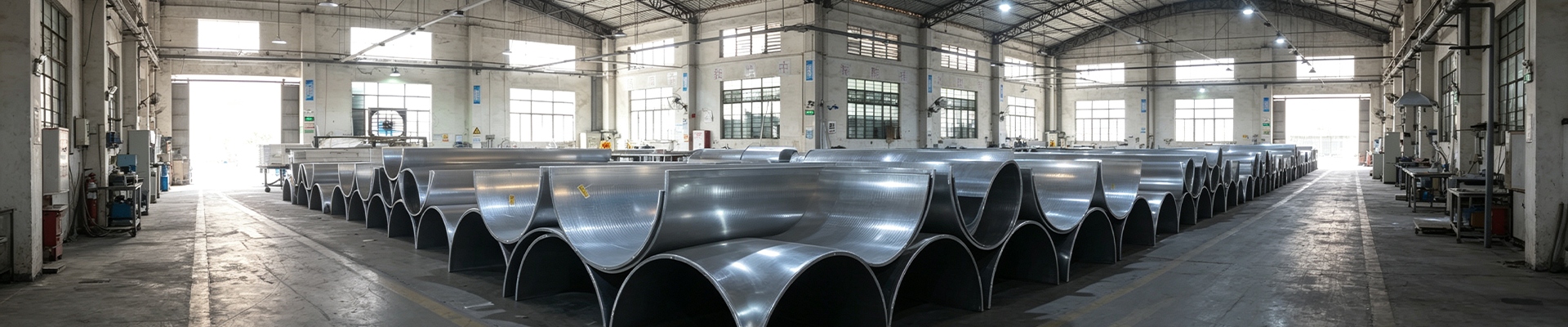
Product Overview
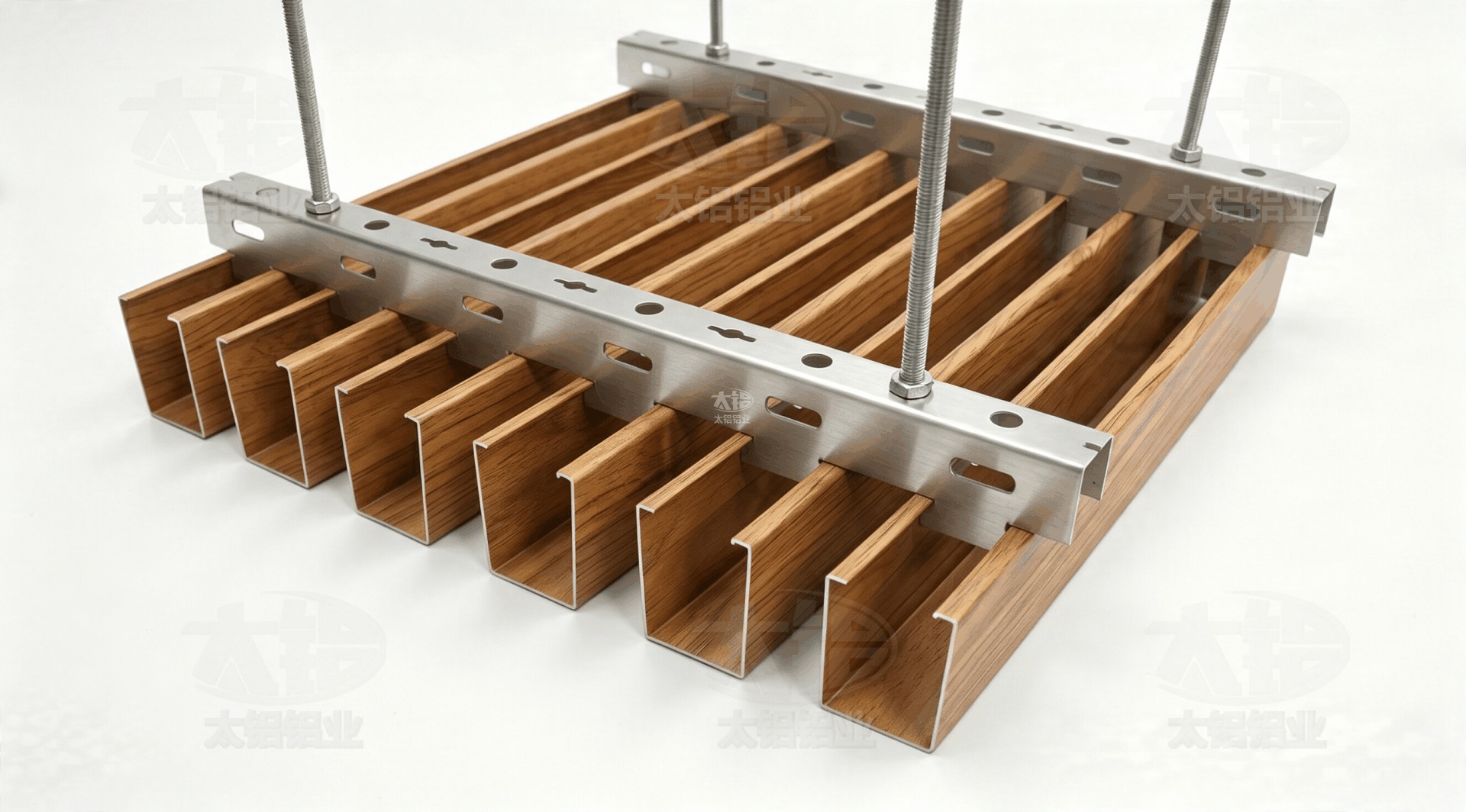
Aluminum square tube ceilings, also known as U-shaped square ceilings or aluminum square tube ceilings, are transparent strip ceiling systems made from aluminum alloy sheets or profiles, formed through cold bending or extrusion molding and surface decoration. They are the mainstream ceiling material for modern commercial spaces and public buildings, widely used in shopping malls, office buildings, transportation hubs, and other scenarios in Guangzhou and South China. The product features continuous strip units, combining three-dimensional decorative effects with practical engineering performance. It meets multiple needs such as spatial design, ventilation and heat dissipation, pipeline concealment, and fire safety inspection, serving as an upgrade solution for traditional grilles and gypsum board ceilings.
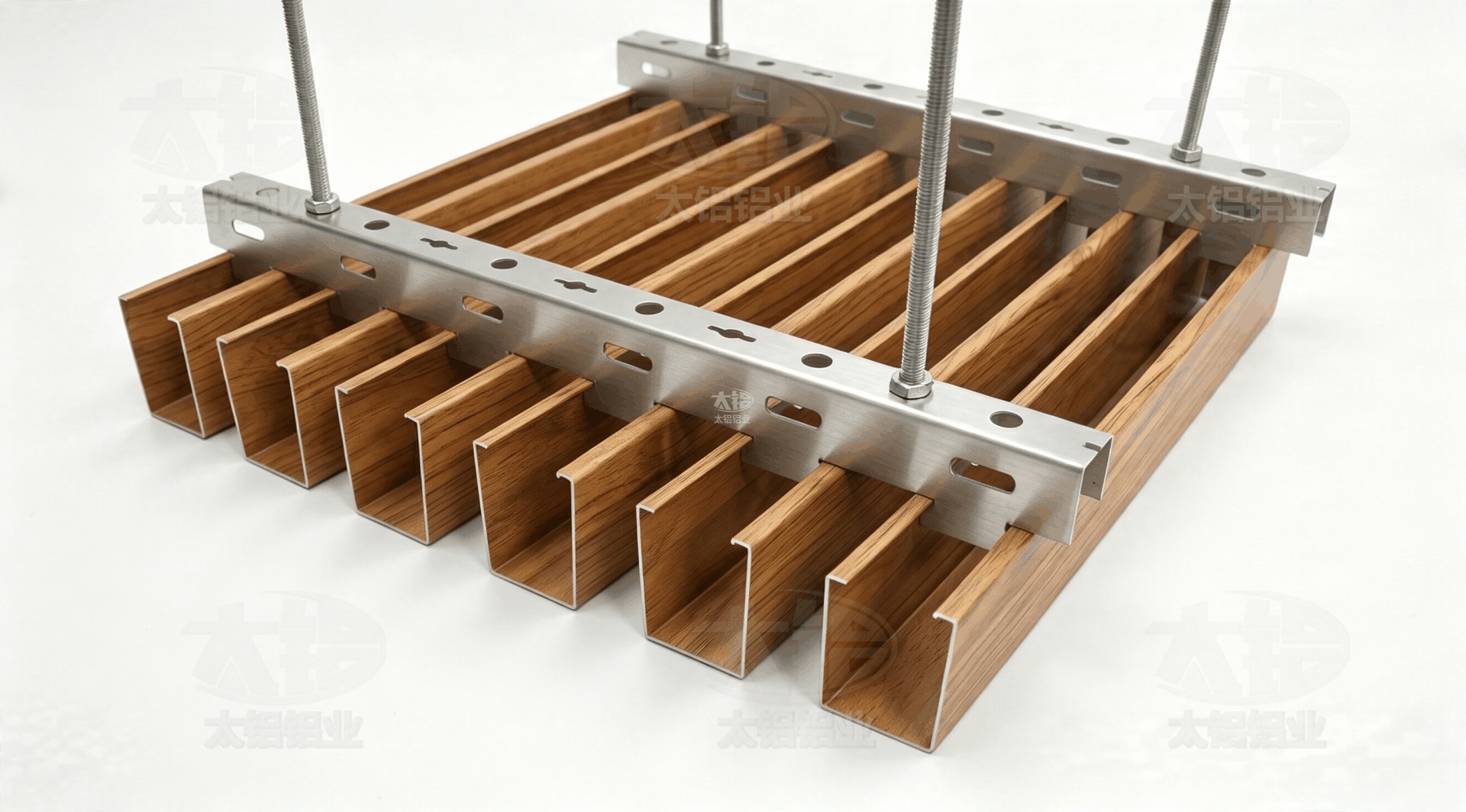
Core Advantage
1. Lightweight and high-strength, with an extremely flat large surface
The hexagonal honeycomb bionic structure is equivalent to dense micro I-beams, achieving extremely high rigidity and flexural strength with an extremely light weight. At the same rigidity, the weight is only 1/3 to 1/5 that of solid aluminum panels, effectively reducing the load on the main building structure; Large panels do not require additional welding of reinforcing ribs, completely avoiding deformation caused by thermal expansion and contraction of the ribs. Even after long-term use, they maintain mirror-level flatness, making them the preferred material for large-panel and minimalist curtain walls.
2. Outstanding sound insulation and heat insulation, with outstanding energy-saving performance
Inside the honeycomb core, a large number of independently sealed air units are formed, effectively blocking sound waves and heat conduction. The air noise insulation can reach 30-40dB, with a thermal conductivity far lower than single-layer metal sheets. It offers excellent thermal insulation performance, significantly reducing building air conditioning energy consumption while effectively blocking outdoor noise and enhancing indoor comfort.
3. Stable weather resistance and excellent deformation resistance
The panel and honeycomb core are made of homogeneous aluminum alloy material, with a consistent coefficient of thermal expansion. When temperature changes, the entire panel expands and contracts synchronously. Combined with a slidable mounting buckle system, it effectively releases temperature stress, thoroughly solving the problems of warping and bulging on large boards; Outdoor fluorocarbon coatings can resist UV rays, acid rain, and salt spray corrosion, and will not fade, crack, or deform after long-term use in normal outdoor environments.
4. Fireproof and environmentally friendly, safe, compliant, and reliable
All-metal structures meet A2 non-combustible fire protection standards, meeting the fire safety acceptance requirements for super high-rise and large public buildings; The boards are non-toxic, odorless, and emit no formaldehyde; after disposal, they can be 100% recycled and reused, meeting green building and low-carbon environmental protection requirements.
5. Diverse customization to meet diverse needs
Supports comprehensive customization of thickness, size, and surface effects, capable of processing perforated sound-absorbing models, wood/stone grain finishes, special-shaped cut designs, and more; It can be used for smooth exterior wall finishes, as well as for indoor ceilings, column wrapping, and partitions, adapting to different functional and design needs.
6. Efficient construction and easy long-term operation and maintenance
The factory has a high degree of prefabrication, with on-site dry-hanging/snap-fit installation, eliminating the need for complex on-site processing and achieving high construction efficiency; The modular structure supports independent disassembly and replacement of individual blocks, facilitating later pipeline inspection and maintenance without the need for large-scale demolition, resulting in low long-term operation and maintenance costs.
Product Classification & Selection Guide
Classified by molding process
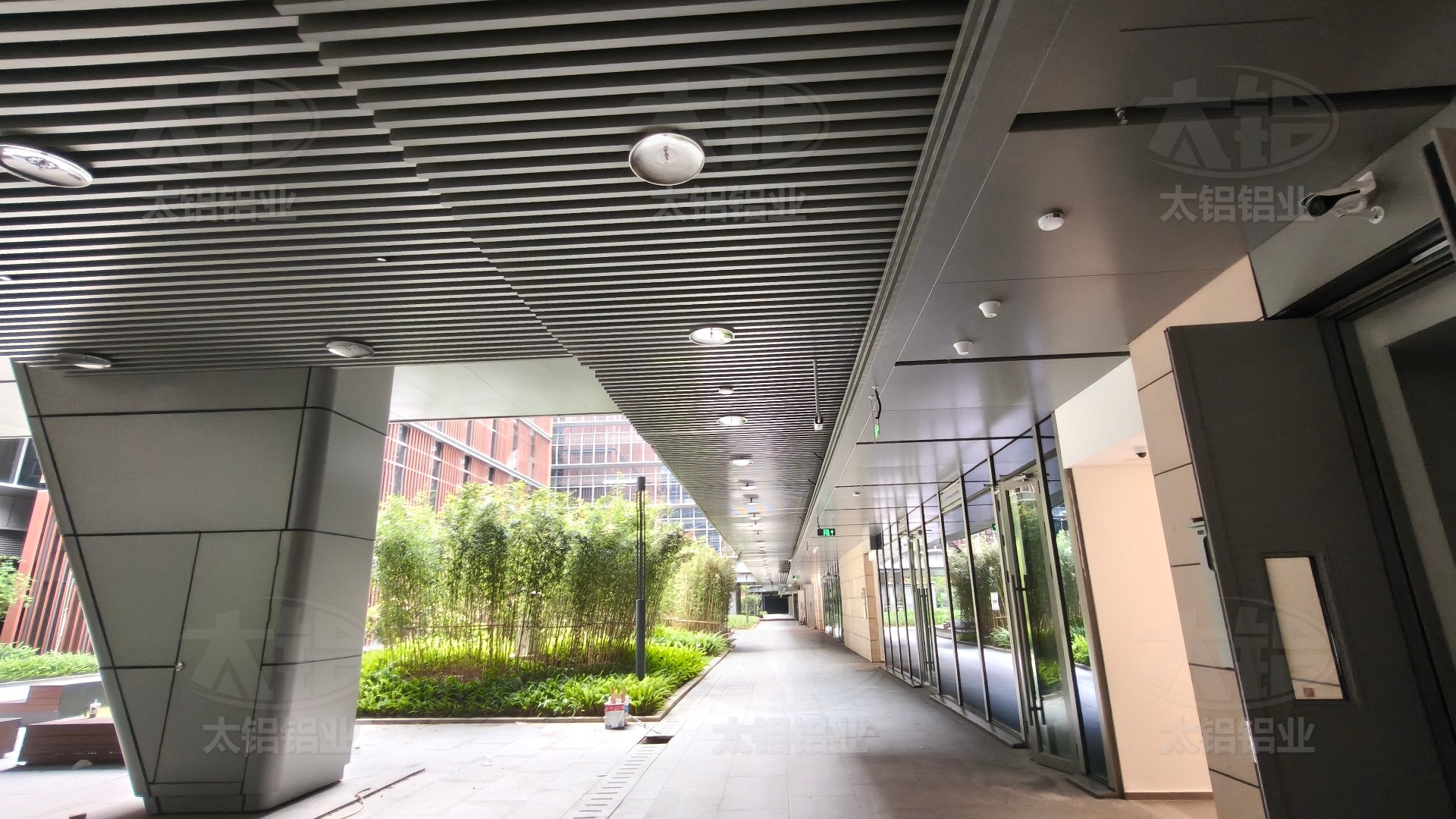
- U-shaped aluminum plate square tube (cold formed version): Made from aluminum plates formed by continuous rolling/cold bending in one piece, with a U-shaped groove cross-section. It is lightweight and cost-effective, paired with a dedicated snap-fit keel installation. It is the most commonly used category for indoor ceilings.
- Profile aluminum square tubes (extruded version): Formed by high-temperature extruded aluminum rods, mostly with a closed rectangular cross-section, uniform wall thickness, high structural strength, excellent straightness, stronger load-bearing capacity and wind resistance, suitable for large-span spaces, outdoor curtain walls, and ceiling scenarios.
- Shaped aluminum square tubes: Formed by secondary processing such as drawing, bending, and welding on the basis of straight square tubes, including curved, wavy, and gradient cross-section styles, commonly used in personalized design scenarios such as specialty commercial spaces and art venues.
Common methods by surface processing
- include polyester bake paint, fluorocarbon spraying, wood grain transfer printing, and anodizing. Among them, wood grain transfer patterns have realistic textures and are the core category of "replacing wood with aluminum"; The fluorocarbon sprayed version offers outstanding weather resistance, protecting against outdoor UV rays and corrosive environments.
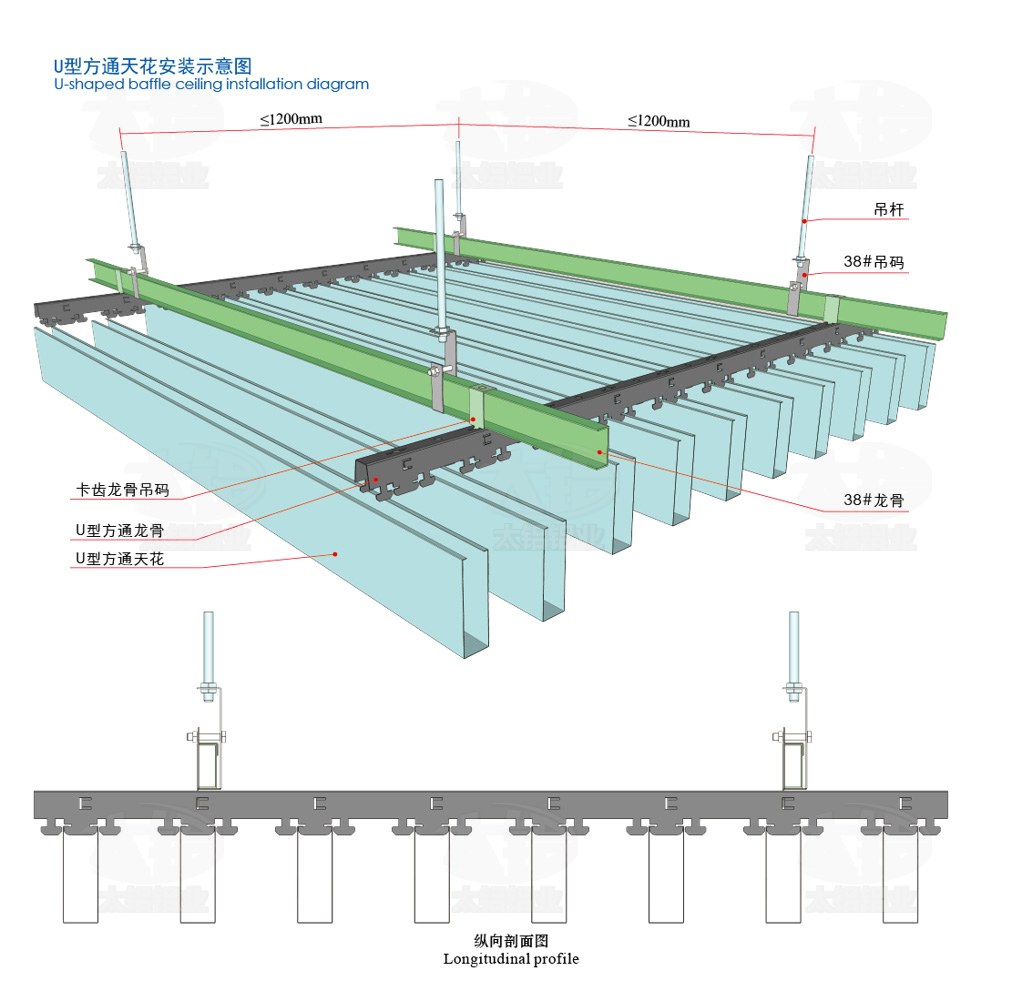
3.Installation system composition
The standard aluminum square tube ceiling system consists of three parts: hangers, dedicated keels, and aluminum square tube units. Accessories such as corner wires and windproof snaps can be supplied as needed:
- The hanger is fixed to the building roof by expansion bolts, bearing the overall system load;
- The keel connects the hanger transversely, with built-in latch/slot structures for fixing square passages. For outdoor scenarios, thickened windproof keels can be selected to enhance wind resistance;
- The aluminum square tube unit can be directly snapped in or fixed to the keel with screws, allowing flexible adjustment of spacing and height to suit different design schemes.
4.Applicable scenarios
- Indoor scenarios: shopping mall atriums, office building corridors, airport/subway station lobbies, venue lobbies, hospitals and schools, dining outlets, home balconies/entrances, etc.;
- Outdoor scenes: building facades, exterior grilles, sunshade ceilings, corridor ceilings, outdoor canopies, etc.
FAQS
1. What are the standard specifications for aluminum squares? How to choose the right size?
- Conventional U-shaped aluminum square tubes typically have a bottom width of 30-150mm, side heights of 50-200mm, and wall thicknesses of 0.6-1.5mm; typical specifications for profile aluminum squares are 40×40mm, 50×100mm, 100×100mm, etc., with wall thicknesses of 1.5-4.0mm. Product length can be customized as needed, with a standard maximum length of 6 meters and extended dimensions for large-span scenarios.
- Selection principle: The higher the ceiling height, the better the Fangtong with larger side heights to enhance the sense of three-dimensionality; For large open spaces, wide specifications and wide-pitch solutions are recommended to enhance transparency; For small areas and low-rise, high-rise spaces, it is recommended to choose narrow specifications and small spacing to avoid a sense of oppression.
2. How should the installation spacing of aluminum square tubes be determined? Is there a standard?
A: There is no mandatory standard for installation spacing; the core is determined based on decoration needs, pipeline concealment requirements, and cost budget:
- Emphasizes transparent decorative effects: spacing can be set between 50-200mm to highlight the layering of lines;
- If concealed top pipeline equipment is needed: it is recommended to keep the spacing less than the width of the square tube bottom, or controlled between 20-50mm to ensure the top structure is not visible from a level viewing angle;
- General conventional engineering solution: spacing to square tunnel width ratio of 1:1 or 1:0.5, balancing decoration and concealment, offering the best cost performance.
3. What is the difference between aluminum square tube ceilings and aluminum panel ceilings? How should you choose?
The core difference between the two lies in their structural form and applicable scenarios, which can be chosen as needed:
| Contrast dimensions | Aluminum square tube ceiling | Aluminum buckle panel ceiling |
|---|---|---|
| Structural morphology | The strip-shaped transparent design gives a strong sense of openness | Block enclosed type, complete top surface |
| Visual effects | Outstanding lines enhance the sense of depth in the space | The top surface is smooth and simple, with a strong sense of integrity |
| Ventilation performance | Good airflow helps dissipate heat from the equipment | Strong sealing and excellent dust and water barrier effects |
| Ease of maintenance | Each unit can be detached, providing ample space for large equipment maintenance | Each piece can be detached, so the pipeline operation space is relatively limited |
| Applicable scenarios | Large public areas, corridors, and storefronts focus on design design | Spaces such as kitchens, bathrooms, and offices that need to be enclosed and dust-proof |
4. How much does an aluminum square tube ceiling cost per square meter? What factors influence the cost?
A: The cost of aluminum square tubes fluctuates greatly, mainly influenced by four major factors: specifications, wall thickness, surface finish, and layout density:
- Standard indoor U-shaped painted model: labor and materials included about 80-150 RMB/㎡;
- Wood grain transfer style: labor and materials included about 120-200 RMB/㎡;
- Aluminum square tubes and outdoor fluorocarbon models: labor and materials included at about 150-300 RMB/㎡;
- Special shapes such as curved and wavy shapes: must be calculated separately according to the design plan, with costs higher than conventional straight clauses.
The denser the layout, the thicker the walls, and the more advanced the craftsmanship, the higher the cost per square meter.
5. Can aluminum square tube ceilings hide pipes, install lighting, and fire protection equipment?
A: Absolutely.
- The open structure of aluminum square tubes can hide fire sprinklers, smoke detectors, air conditioning vents, and strong and weak electrical pipelines inside the ceiling, preserving the overall aesthetics when viewed at level level.
- Fixtures can be installed as dedicated Fangtong LED lamps, or downlights and track lights can be directly fixed to the building's ceiling or keel, allowing illumination through the gaps in the fangtongs without the need for large, additional openings.
6. Is the aluminum square tube waterproof and fireproof? Can it be used in bathrooms or outdoors?
A: The aluminum alloy substrate itself is waterproof, rust-resistant, and mildew-resistant, with a fire resistance rating of Class A non-combustible, meeting fire safety acceptance requirements.
- For indoor damp environments such as bathrooms and balconies, aluminum square tubes with polyester baking paint or anodizing processes can be used normally;
- Outdoor scenarios: Must use aluminum square tubes + fluorocarbon spraying process, combined with thickened windproof keels to enhance wind resistance, UV resistance, and corrosion resistance, preventing fading and deformation issues from long-term outdoor use.
7. Is it difficult to install aluminum square tubes? How long is the construction period?
- Aluminum square tubes are a modular dry operation construction method, with mature technology and low installation difficulty. The standard process is: snap line positioning→ fixed hangers→ installation leveling keels→ clamping square passes→ fine-tuning acceptance.
- For typical indoor spaces under 100㎡, installation can be completed in 1-2 days by 2-3 professional workers; Large-scale projects can operate in multi-team assembly lines, with construction efficiency far higher than traditional ceilings such as gypsum board and mineral wool board, and is ready to use immediately with no maintenance cycle.
8. How should aluminum square tubes be cleaned and maintained? How long is the normal lifespan?
A: Daily maintenance is simple; surface dust can be wiped off with a feather duster or a dry soft cloth; If dust accumulates or stains are heavy, dilute a neutral detergent with water, wipe with a soft cloth, and then rinse clean with clean water. Do not use steel wool or strong acid or alkali cleaners to avoid scratching or corroding the surface coating.
Under normal indoor conditions, high-quality aluminum square tubes can last 15-20 years; The outdoor fluorocarbon model can be used for over 10 years under normal climate conditions, with no need for refurbishment or replacement during this period—only regular cleaning.
9. Will wood grain aluminum square tubes fade? What are the advantages compared to solid wood ceilings?
- High-quality heat-transferred wood-grain aluminum square tubes, with no obvious fading after 5-8 years of indoor use; The outdoor-specific weather resistant wood grain model has stronger UV resistance and a longer service life.
- Compared to solid wood ceilings, aluminum Fangtong has significant advantages: waterproof, moisture-proof, mold-resistant, A-grade fire protection for greater safety, lightweight and reduced building load, no need for regular painting or maintenance, and lower overall operating costs. It is a cost-effective alternative to wood-textured ceilings in commercial spaces.
10. Can aluminum square tubes only be used for flat ceilings? Can you do styling?
A: Not limited to straight arrangements, the shape is highly versatile. In addition to conventional horizontal vertical rows, staggered arrangements of varying heights can create a sense of stepped layering, custom curved or wavy aluminum square tubes for curved ceilings, and combinations of different colors and specifications for patchwork combinations, enabling gradient and patchwork patterns to enrich design effects and meet various personalized space design needs.