Product Overview
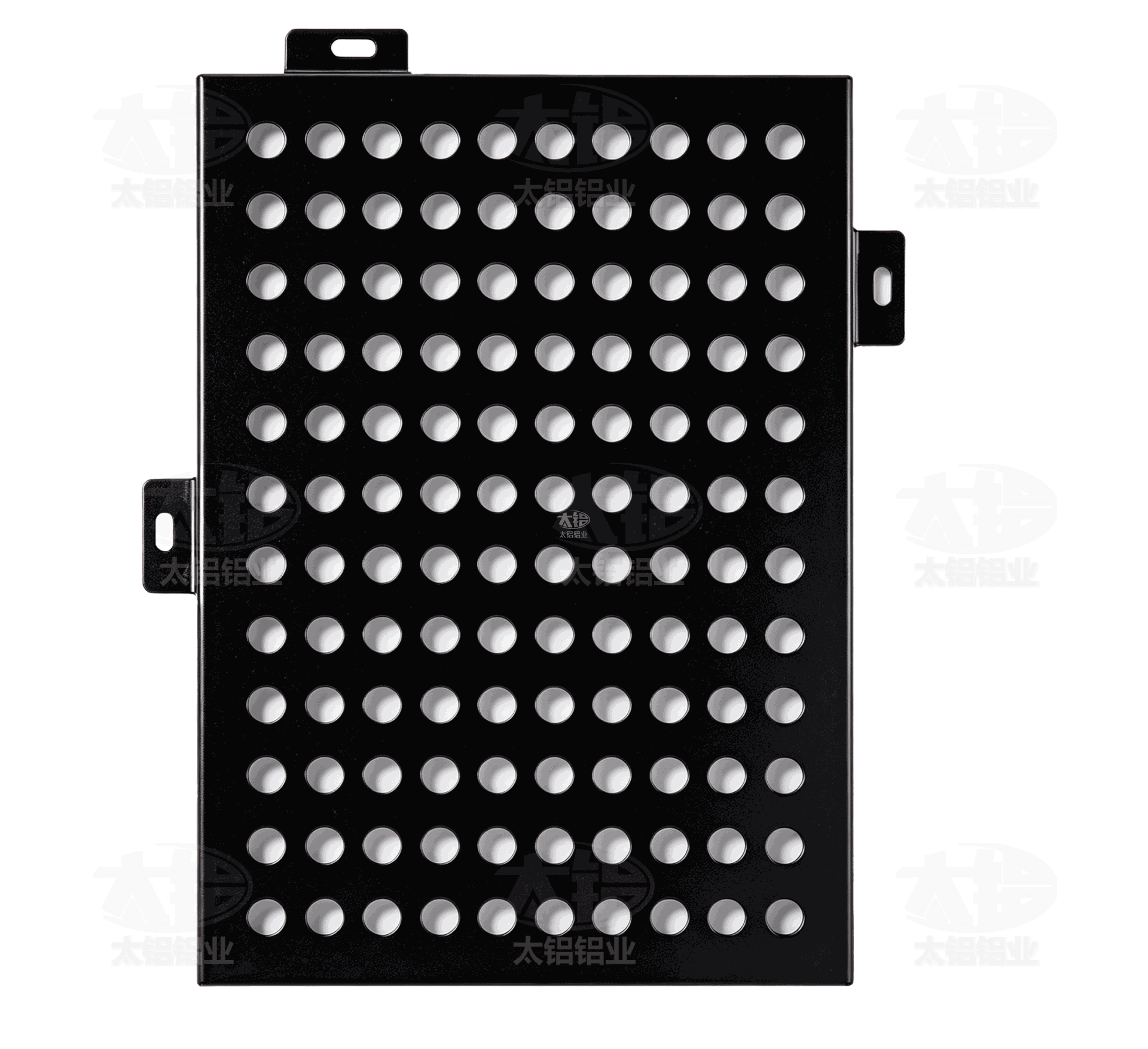
Perforated aluminum panels are metal decorative materials made from high-grade aluminum alloy sheets as the base material, which are formed with regular or customized holes on the panel surface by CNC punching machines or laser cutting, and then processed through bending, welding, grinding, spraying, and other processes. While retaining the inherent advantages of aluminum panels such as lightweight high strength, weather resistance, and flexible processing, the product is endowed with unique functions such as breathability and light transmission, sound-absorbing and noise reduction, visual transparency, and rich shapes. It is widely used in building curtain walls, indoor suspended ceilings, sound-absorbing walls, sunshade grilles, and landscape decoration.
Depending on the perforation method, hole design, and surface treatment, perforated aluminum panels can form a complete product system ranging from standard punching to artistic patterns, and from single aperture to gradient aperture. They combine functionality and decoration, serving as the core material for achieving the trinity of "light and shadow effect + acoustic performance + metallic texture" in modern architecture.
Core Advantage
1.Light and shadow are transparent, with a lively
perforated facade effect. The perforated design transforms the aluminum panels from a "solid surface" into a "semi-transparent surface," allowing light to pass through the holes and create dappled light indoors. At night, paired with a backlit light box, it creates a unique lighting effect; Gradient aperture and pattern perforations further transform the building facade into a dynamic painting, greatly enhancing the building's recognition and artistic appeal.
2.Sound absorption and noise reduction, with excellent acoustic performance.
Perforated aluminum panels combined with glass wool, rock wool, or polyester fiber sound-absorbing cotton behind can form an efficient resonant sound-absorbing structure, effectively reducing indoor reverberation time and absorbing mid- to high-frequency noise; The noise reduction coefficient (NRC) of micro-perforated panels can reach 0.6–0.9, making them an ideal material for venues with high acoustic demands, such as concert halls, lecture halls, subway stations, and computer rooms.
3.Ventilation and breathability, energy-saving and consumption-reducing
perforated structure provide panels with excellent ventilation and breathability. When used on building exterior walls, they promote air circulation and reduce wall heat island effects; When used in shading systems, it blocks direct sunlight while maintaining natural ventilation, effectively reducing air conditioning energy consumption and aligning with the green building concept.
4.Lightweight, high-strength, structurally safe and reliable
made of rust-resistant aluminum alloys such as 3003 and 5005. After bending, the panels form a box-type structure, offering good rigidity and high strength, maintaining good flatness even at large sizes; The surface density is only 3–8 kg/㎡, significantly reducing the structural load on buildings and offering excellent seismic performance.
5.Weather-resistant and corrosion-resistant, long-lasting service life.
The surface can be selected with professional coatings such as fluorocarbon spray (PVDF), polyester spray, and powder coating. The fluorocarbon coating resists UV rays, acid rain, and salt spray corrosion, with a color retention period of 15–20 years. The aluminum alloy base material does not rust, mold, or release formaldehyde, and its normal outdoor service life can reach 20–30 years.
6.Flexible customization, adaptable to various design
aperture diameters (1mm–50mm), hole spacing, arrangement methods, and perforation rates can all be customized as needed; Can process special shapes such as curved shapes, curved surfaces, and irregular edges; Surface colors include solid colors, wood grain, stone grain, brushed finishes, mirror finishes, and more, meeting the personalized design needs of various buildings.
Product Classification & Selection Guide
1.Structural and installation diagram
- The perforated aluminum panel system adopts a dry-hanging installation structure, consisting of embedded parts, galvanized angle/square steel frames, aluminum alloy subframes, perforated single panel units, and sealing strips. The edges of the panels are formed by CNC bending and matching with specialized corner panels. During installation, the corner panels are fixed to the skeleton subframe, with gaps left between panels or tightly assembled, and foam rods filled with foam rods and weather-resistant sealant applied during installation.
2.Perforated panels have holes on the board surface. During installation, pay attention to
- Avoid holes and the frame position to prevent the keel from blocking holes that affect light transmission and ventilation;
- If the back needs to be lined with sound-absorbing cotton, non-woven fabric, or aluminum backing, it should be pre-installed at the factory or installed on-site;
- Artistic perforated boards must be installed in the order of numbering to ensure accurate pattern splicing.
3.Application Scenarios
Perforated aluminum panels, with their dual attributes of "function + decoration," are widely used in various architectural scenarios:
- Building curtain walls: facades and shading systems for commercial complexes, office buildings, cultural venues, and hotels
- Indoor suspended ceilings: airport terminals, metro station halls, high-speed rail stations, convention centers, shopping mall atriums
- Acoustic walls: concert halls, lecture halls, cinemas, recording studios, computer rooms, industrial plants
- Interior partitions: semi-transparent partitions and image walls in offices, hotel lobbies, and showrooms
- Sunshade grilles: shading exterior buildings, louvered facades, skylights
- Landscape decoration: urban furniture, fences, art installations, corridor frames, bridge decoration
- Brand image: storefront signage, brand store facade, logo perforation image
FAQS
1: What is the difference between perforated aluminum panels and ordinary aluminum panels?
A: Ordinary aluminum panels have solid surfaces, mainly serving as enclosure and decoration; Perforated aluminum panels feature regular holes on the surface, which, in addition to decorative functions, also provide light, breathability, and sound absorption, making the facade more dynamic. Both have basically the same base material, processing technology, and installation methods. Perforated panels require more punching steps, making them slightly more expensive than ordinary aluminum panels.
2: How to choose perforation rate? Is higher always better?
A: No. Perforation rate should be balanced according to functional requirements: for ventilation, choose 20%–40%; For sound absorption, 15%–25% is recommended (best when combined with sound-absorbing cotton); For decorative light transmission, 5%–30% can be selected according to the pattern design. Excessively high perforation rate reduces panel rigidity, affects flatness, and increases costs, so it should be reasonably selected while meeting functional requirements.
3: How effective is the sound absorption of perforated aluminum panels?
A: Perforated panels have limited sound absorption and must be combined with the sound-absorbing cotton behind (glass wool/rock wool/polyester fiber wool) and an air layer to form an efficient sound-absorbing structure. The combined noise reduction coefficient of micro-perforated plate (hole diameter ≤2mm) + sound-absorbing cotton can reach 0.6–0.9, effectively absorbing mid- and high-frequency noise. Specific acoustic properties need to be designed and calculated based on pore diameter, perforation rate, sound-absorbing cotton thickness, and cavity depth.
4: Will perforated boards accumulate dust and be difficult to clean?
A: Pores do indeed accumulate dust more easily than solid panels, but fluorocarbon coatings have smooth surfaces and low adhesion, so regular rainwater washing can remove most of the floating dust; For indoor use, regular cleaning with a soft brush or vacuum cleaner is recommended. Products with a small pore diameter (≤2mm) and high perforation rate are relatively difficult to clean and are recommended for indoor environments with less dust.
5: Can you make patterns, text, or logos through holes?
A: Yes, you can. Through CNC programming, any text, logo, portrait, landscape painting, and other patterns can be converted into piercing paths, and changes in aperture size or hole spacing can be rendered with grayscale levels, achieving a "translucent imaging" effect. Artistic perforated boards must provide high-definition vector images, with the manufacturer detailing the pattern and layout numbering, and strictly stitching according to the numbering during installation.
6: Can perforated aluminum panels be made into curved or irregular shapes?
A: Yes, you can. Through CNC bending, arc rolling, welding, and other processes, it can process single-curved arc plates, hyperbolic arc plates, and special-shaped bent plates. However, note that the perforation of the curved plate should be completed in a flat plate state before bending the arc. During the bending process, the holes may undergo slight deformation, so the process feasibility of large-curvature molding must be evaluated in advance.
7: Will perforated panels leak from exterior walls?
A: Perforated panels themselves are permeable and usually serve as a "decorative outer layer" when used on exterior walls. Behind them must be a waterproof backing panel, waterproof breathable membrane, or solid wall to form a "double-layer leather" structure; Rainwater passing through the perforated panels is blocked by the inner waterproof layer and discharged along the drainage path. The waterproofing system must be clearly defined during design; perforated panels cannot be used directly as waterproof enclosure layers.
8: What is the service life of perforated aluminum panels?
A: The aluminum alloy base material itself is non-corrosive, and when combined with a fluorocarbon coating (PVDF), it can last 20–30 years under normal outdoor use; Polyester coatings can be used outdoors for about 10–15 years, and indoors for up to 15–20 years. The actual lifespan is closely related to the usage environment, coating type, and installation quality. It is recommended to use fluorocarbon coatings and increase film thickness in coastal and heavily polluted areas.