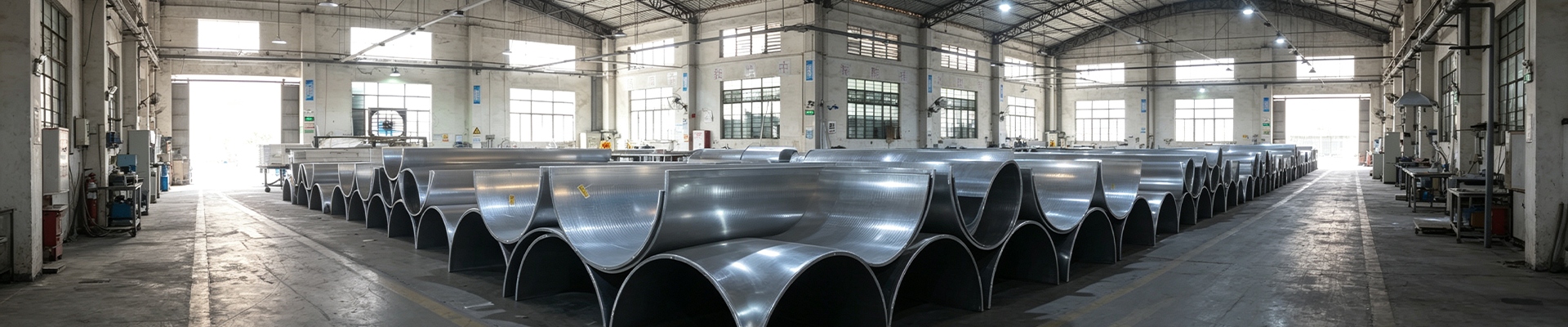
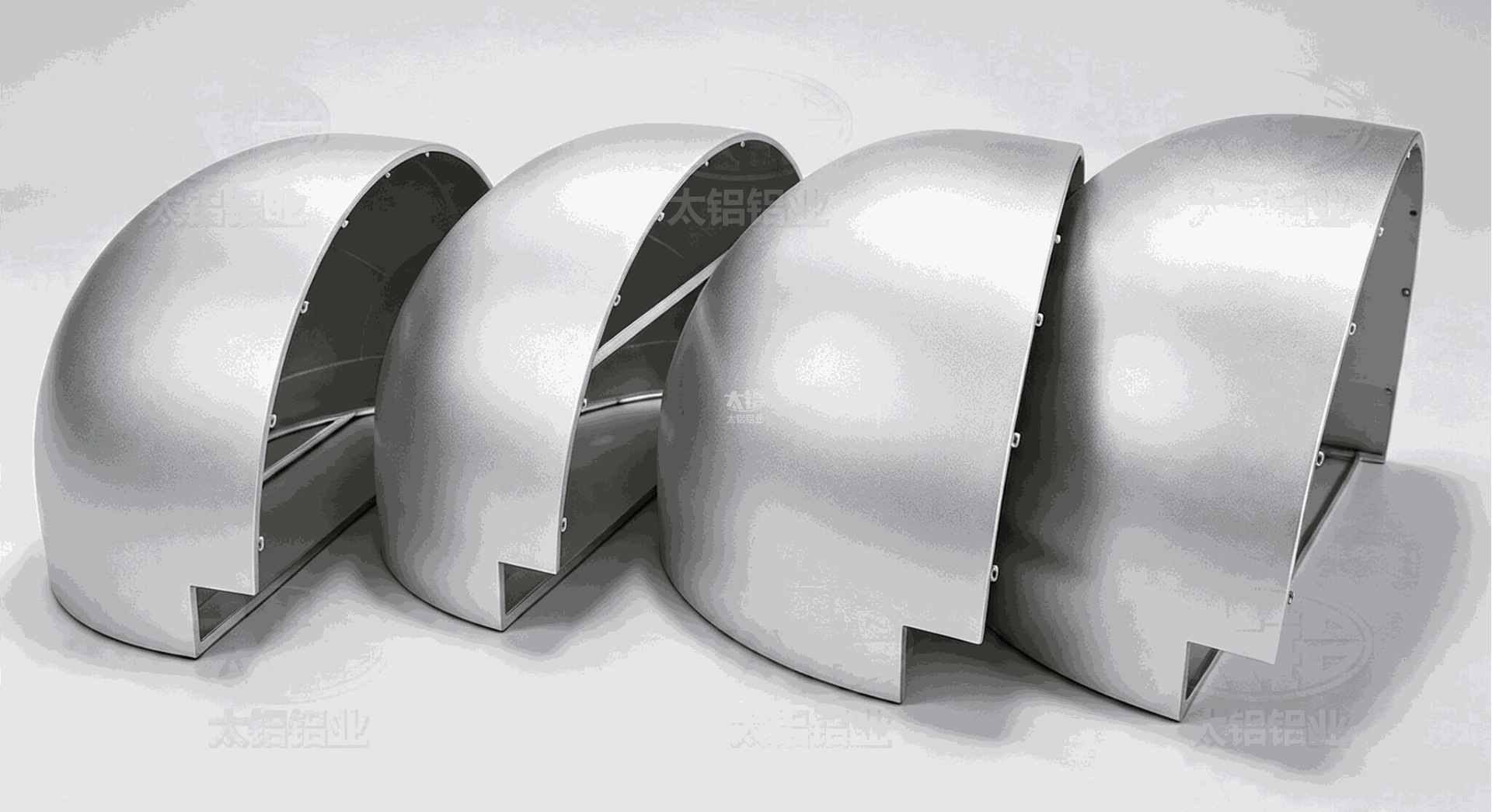
Product Overview
Hyperbolic aluminum panels are the most technically challenging shaping products in the aluminum panel category. They refer to panels that undergo simultaneous bending and deformation in the X and Y directions, forming spherical, ellipsoidal, twisted, and other double-curvature surface shapes. The product is made from high-strength aluminum alloy panels as the base material, processed through multiple precision processes including parametric modeling, custom molds, skin stretching/hydraulic stamping, welding calibration, and surface treatment. It can be perfectly implemented in high-difficulty special-shaped architectural designs and is the core curtain wall material for modern landmark buildings.
Unlike the unidirectional curved structure of monocurved panels, double-curved aluminum panels can achieve richer spatial curved surface shapes, combining the structural strength and artistic expression of metal building materials. Combined with BIM digital processing, they achieve millimeter-level precision control. They are widely used in stadiums, cultural and art centers, transportation hubs, super high-rise landmarks, and other high-end buildings for irregular curtain walls and interior designs. They are a landmark product that demonstrates the technical strength of aluminum panel manufacturers.
Core Advantage
1. Extremely High Styling Freedom And Strong Artistic Expression
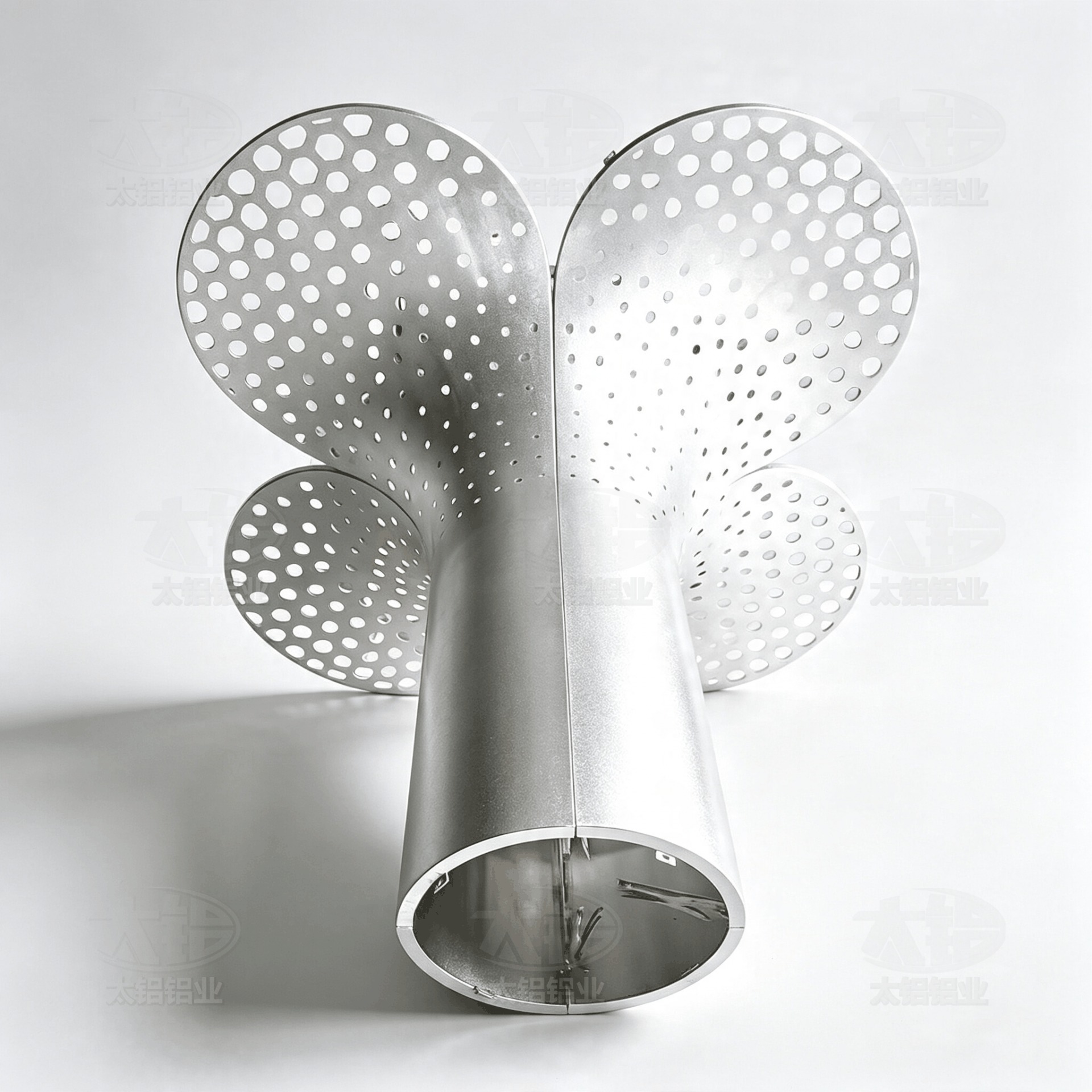
Breaking through the design limitations of flat and single-curved boards, it can achieve any double curvature shapes such as spherical, ellipsoidal, twisted, wavy, or freeform surfaces, perfectly restoring the designer's creative vision; By combining techniques such as perforation, hollowing, and gradients, highly recognizable architectural surfaces can be created, giving buildings a unique artistic texture and landmark attributes.
2. Digital Precision Machining With Excellent Forming Accuracy
Using Rhino+Grasshopper parametric modeling, combined with finite element analysis to predict rebound and pre-compensate, precise machining is achieved through custom molds and CNC forming equipment, with curvature errors controlled within ±0.5mm; Before leaving the factory, a 1:1 pre-assembly inspection is conducted to ensure uniform seams during installation, smooth and smooth surfaces, and no obvious bumps or misalignments.
3. Outstanding Structural Strength Snd Excellent Wind Pressure Resistance
The hyperboloid structure itself has stronger structural rigidity, and combined with the rear rib system, it can withstand higher positive and negative wind pressures, meeting the wind pressure resistance requirements of curtain walls in super high-rise buildings and coastal areas with strong winds; At the same thickness, its deformation resistance is superior to that of flat aluminum panels, and it is less likely to deflect over large spans, providing high structural safety and redundancy.
4. Excellent Weather Resistance And Long Service Life
The outdoor model uses a three-coat, two-bake fluorocarbon spraying process, with a PVDF resin content of ≥70%. It can pass a 4,000-hour accelerated artificial aging test and a 3,000-hour salt spray test, resisting UV rays, acid rain, coastal salt spray, and extreme temperature changes. Under normal outdoor conditions, it can maintain color, powder, or crack for over 20 years.
5. High Degree Of factory Prefabrication, Efficient On-site Installation
All surface processing, grinding, and spraying are completed in the factory; on-site only 3D adjustable hangers are needed for attachment and fixing, with no need for on-site cutting or secondary processing; Combined with BIM 3D positioning technology, it enables efficient and precise installation, with minimal construction pollution and short cycles, meeting the schedule requirements of large public construction projects.
6. Environmentally Friendly, Safe, and Compliant, With Easy Long-term Operation and Maintenance
The all-aluminum alloy base material is non-toxic, odorless, and emits no formaldehyde, meeting Class A non-combustible fire protection standards and meeting the fire safety acceptance requirements of various public buildings; The surface coating is dense and smooth, with good self-cleaning properties. It can be kept clean even after being washed by rainwater, and only simple cleaning and maintenance are needed later. The long-term cost of use is much lower than that of stone, GRC, and other special-shaped curtain wall materials.
Product Classification & Selection Guide
1.Classified By Surface Shape
- Spherical/ellipsoid hyperbolic panels: Curved hyperboloids with uniform curvature, commonly used for domes, spherical buildings, and curved columns, and are the most common shapes among hyperbolic panels.
- Twisted double-curved panel: a curved surface twisted along the diagonal, with a lively and dynamic shape, commonly used for irregular building facades, spiral staircases, and art installations.
- Wavy hyperbolic panel: A continuously undulating bidirectional curved surface, combining the smoothness of single-curved curves with the three-dimensional structure of hyperboles, commonly used in commercial complex facades and venue-shaped walls.
- Freeform hypercurved slab: irregular curved surfaces with irregular curvature, custom-processed according to design drawings, suitable for challenging landmark architectural designs.
2.Classified By Molding Process
- Skin stretch molded version: formed by bidirectional stretching and bonding with the mold by a stretching machine, with uniform curves and no wrinkles, suitable for large double-curved plates with gentle curvature, offering high production efficiency.
- Mold Stamping Model: Custom steel mold hydraulic stamping forming, offering high precision and good consistency, suitable for hyperbolic molds with large curvature and high repeatability.
- Segmented spliced molded version: Complex large curved surfaces are disassembled into multiple small units for on-site assembly and molding, resulting in lower cost and suitable for extra-large-scale irregular curved surfaces.
3.Classified By Functional Application
- Exterior curtain wall model: fluorocarbon surface, equipped with reinforcing ribs and dry hanging system, resistant to wind pressure and weather, specially designed for building envelope structures.
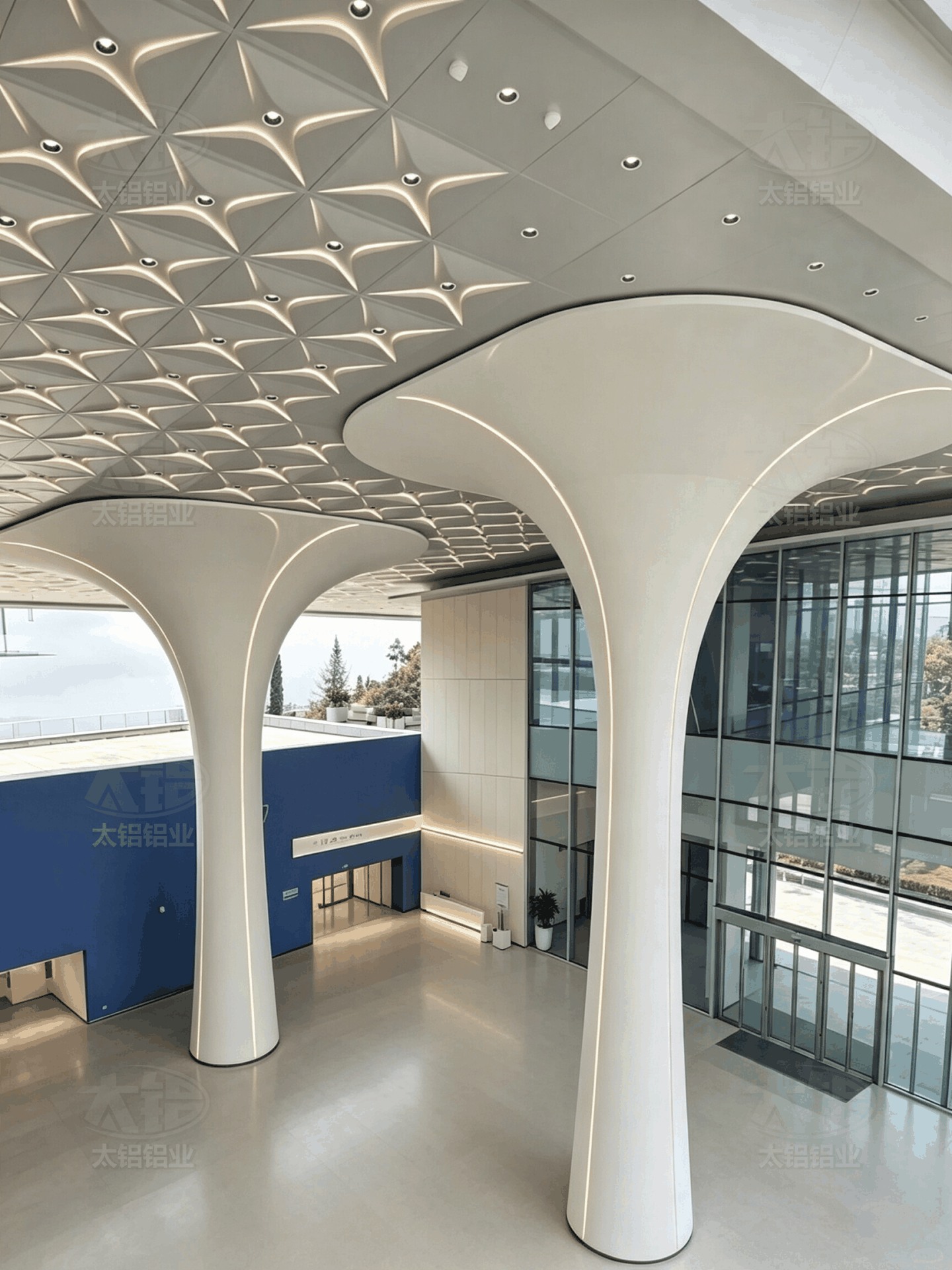
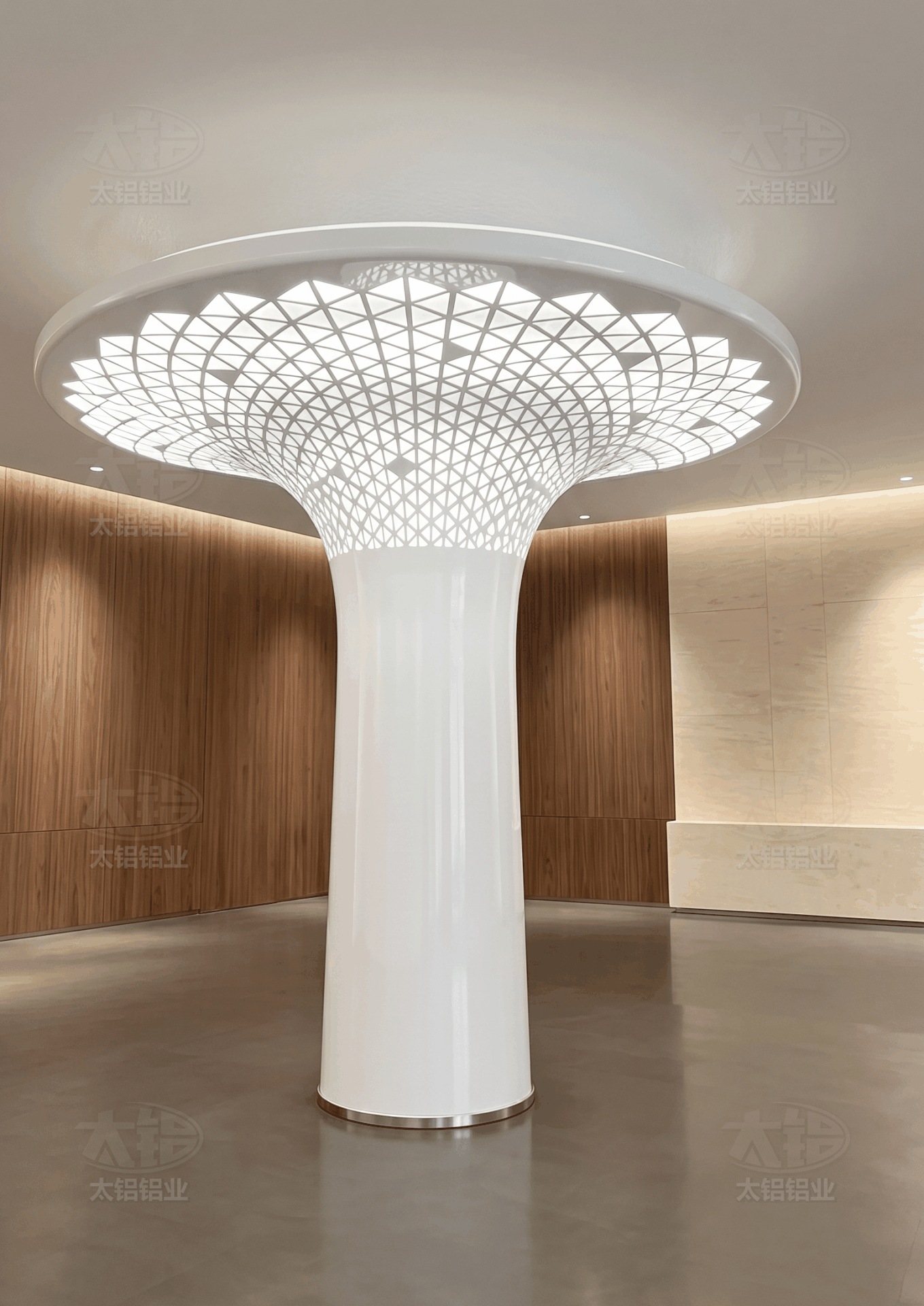
- Interior styles: polyester/wood grain surface with high flatness, mostly used in indoor lobbies, column wrapping, ceilings, and other irregularly shaped areas.
- Perforated sound-absorbing model: The panel is stamped with micro-holes, with sound-absorbing materials on the back, balancing styling and acoustic functionality, suitable for venues, theaters, and similar spaces.
4.Installation System Composition
The standard double-curved aluminum panel curtain wall system consists of a vertical main keel, horizontal auxiliary keel, three-dimensional adjustable hangers, stainless steel corner panels, double-curved aluminum panels, and neutral weather-resistant sealant:
- The main keel is connected to the main building through embedded parts, bearing the overall load;
- The 3D adjustable hangers can be fine-tuned in the X/Y/Z directions to compensate for installation errors and ensure precise and smooth curved surface splicing;
- The panels are locked to hangers via corner brackets, with weather-resistant glue filling the panel joints for waterproof sealing, while reserving expansion and contraction gaps to release thermal stress.
5.Application Scenarios
- Landmark public buildings: stadium domes, convention centers, cultural and arts centers, grand theaters, museum uniquely shaped curtain walls
- Transportation hub buildings: airport terminals, high-speed rail station buildings, metro station halls, port passenger transport center facades
- Commercial super high-rise buildings: super high-rise office buildings, star-rated hotels, and special-shaped curtain walls and styling nodes in commercial complexes
- Interior features: irregular ceilings in the hotel lobby, curved columns, artistic feature walls, and spiral staircase finishes
- Specialized styling applications: spherical buildings, landscape installations, art sculptures, flagship brand store image walls
FAQS
1. What are the core differences between double-curved aluminum panels and single-curved curved aluminum panels?
A: The core differences lie in bending direction and machining difficulty:
- In terms of shape: single curved panels bend only in one direction, such as a cylindrical column; The hyperbolic plate bends simultaneously in two orthogonal directions, enabling more complex shapes such as spherical and twisted surfaces.
- In terms of process: single curved plates can be formed by rolling, bending, and bending, with a simple process and low cost; Hyperbolic plates require custom molds and drawing/stamping forming, making processing difficult and requiring high precision.
- Price: Hyperbolic plates typically cost 2-4 times more than monocurved plates, depending on curvature complexity.
- Application: For conventional curved shapes, single-curved panels are sufficient; high-difficulty irregular curved surfaces and landmark buildings only require double-curved panels.
2. What is the machining accuracy of double-curved aluminum panels?
A: High-quality manufacturers use parametric modeling and CNC forming processes, with curved surface curvature errors controlled within ±0.5mm, and diagonal errors of ≤3mm per panel; Before leaving the factory, a 1:1 pre-assembly is performed, with an overall surface splicing error of ≤1mm, ensuring the curved surface is smooth and smooth after installation, with no obvious misalignment or uneven gaps.
3. Can double-curved plates with very low curvature be made? Are there any processing restrictions?
A: There are certain process limitations: conventional skin stretching processes recommend a curvature radius of ≥500mm; if the radius is too small, problems such as sheet cracking and surface orange peel texture can occur; Molds with minimal curvature and large deformation can be achieved using mold stamping or segmented splicing processes, with design drawings required for process feasibility evaluation.
4. Can double-curved aluminum panels be perforated or hollowed out? Will it affect molding accuracy?
A: Custom perforated and hollowed-out patterns are available. The process sequence of "molding first, punching later" is usually adopted to avoid punching affecting surface forming accuracy; Hollow-out patterns should avoid areas of stress concentration to prevent cracking and deformation during forming. Before customization, structural verification is conducted, and hollowed-out designs are implemented while ensuring shape and strength.
5. Can double-curved aluminum panels be used in coastal areas with high salt spray?
A: Absolutely possible, but you need to select a specific model: use 3003/5052 anti-rust aluminum alloy substrate, with a three-coat, two-bake fluorocarbon coating on the surface, and come with 316 stainless steel dry-hanging accessories and neutral weather-resistant sealant. This effectively resists salt spray corrosion and can maintain a service life of 15-20 years in normal coastal environments.
6. Is it difficult to install double-curved aluminum panels? Are there requirements for construction teams?
- The installation difficulty is higher than that of flat aluminum panels, which places certain demands on the construction team's three-dimensional positioning capabilities.
- Reputable manufacturers provide complete BIM installation positioning diagrams and numbering systems, combined with 3D adjustable hangers. After technical briefing, professional curtain wall construction teams can begin construction; Manufacturers of complex molding projects usually send technical personnel on-site to provide guidance and ensure installation results.
7. What is the approximate cost per square meter of double-curved aluminum panel?
A: Prices are greatly affected by curvature complexity, sheet thickness, surface finish, and individual block size, with significant differences:
- Flat spherical/ellipsoid standard models: about 450-800 RMB/㎡
- Medium curvature distortion/wave style: about 700-1200 RMB/㎡
- High-difficulty freeform surfaces and irregular hyper-curved models: about 1200-2500 RMB/㎡
- Special processes such as perforation, hollowing, and wood grain add extra costs on top of this.
Overall, it is a high-end styled curtain wall material, and specific design drawings must be provided for a precise quotation.
8. Will double-curved aluminum panels deform during thermal expansion and contraction?
- Under standard design and installation, there will be no obvious deformation issues.
- The double-curved plate itself is made of homogeneous aluminum alloy, with uniform thermal expansion; The installation system uses sliding hangers and weather-resistant adhesive joints, with a reserved temperature expansion and contraction gap to effectively release thermal expansion and contraction stress; Moreover, the hyperboloid structure has stronger rigidity and better deformation resistance than flat plates, so warping and bulging do not occur under normal temperature differences.
9. Is the wood grain double-curved aluminum panel good? Will there be color differences?
- High-quality heat transfer wood grain technology can achieve a uniform wood grain effect on a double-curved surface, with clear grain and a warm texture.
- Because the angle of light exposure on the curved surface varies in all directions, there will be natural visual differences in light and shadow. This is a normal phenomenon in curved surface modeling, not a color difference; Reputable manufacturers use transfer films from the same batch to ensure consistent base colors for boards for the same project, resulting in a unified and natural effect for large-area installation.
10. What documents are required for custom double-curved aluminum panels? How long is the cycle?
- Customization requires providing complete 3D design drawings (in formats like Rhino/Revit) or clear floor elevations + curvature annotations, specifying material, thickness, and surface craftsmanship requirements.
- Production cycle depends on molding complexity and quantity: conventional molding takes about 15-25 days for 100-500㎡; Complex shapes and large-scale projects require 25-40 days; The special molding cycle including mold opening is correspondingly extended; the specific period is subject to the confirmation of the plan.