
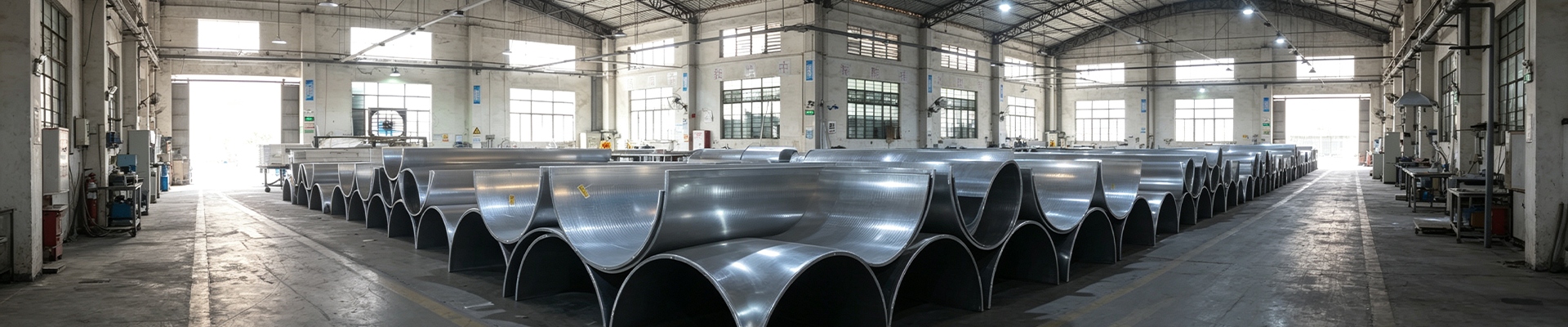
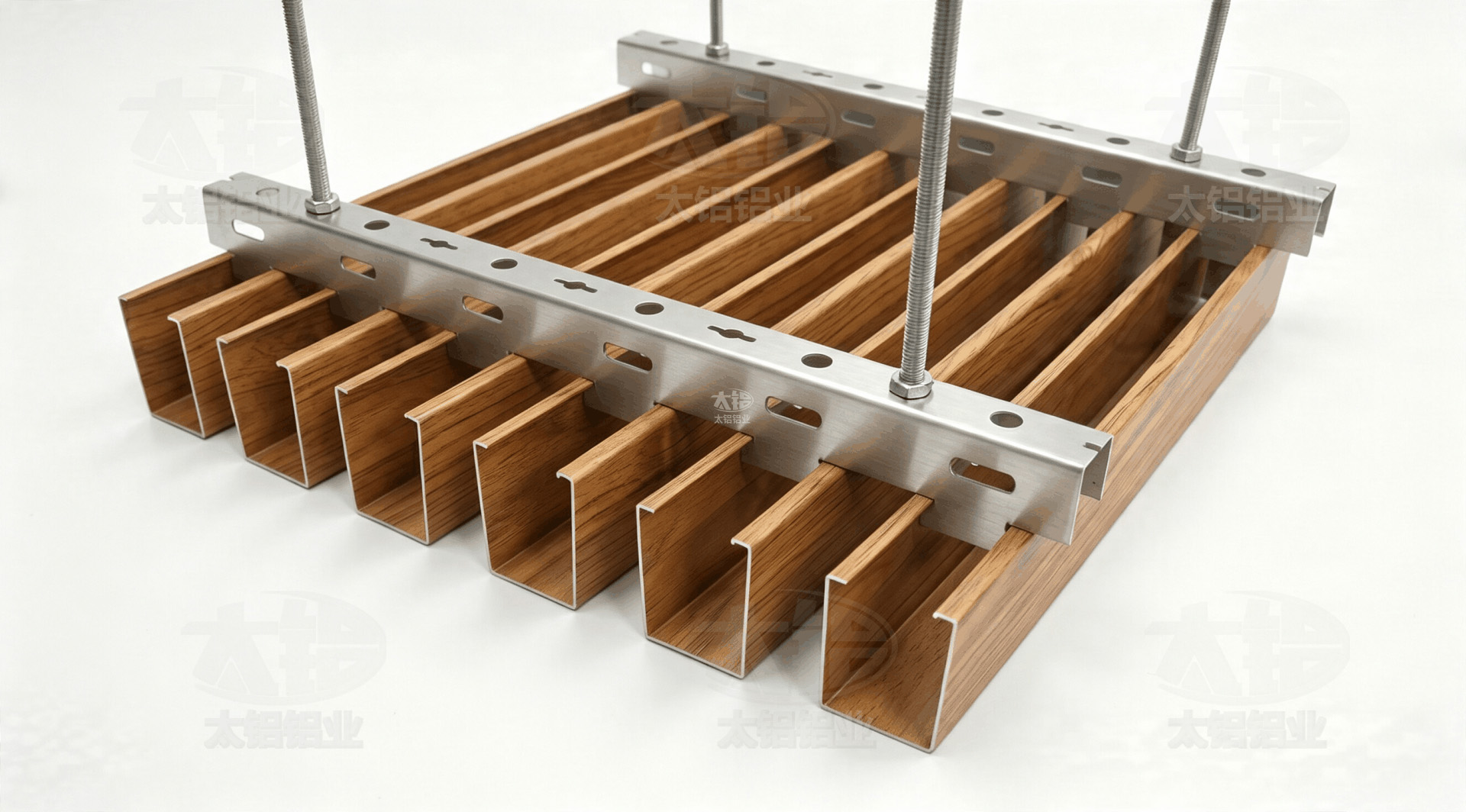
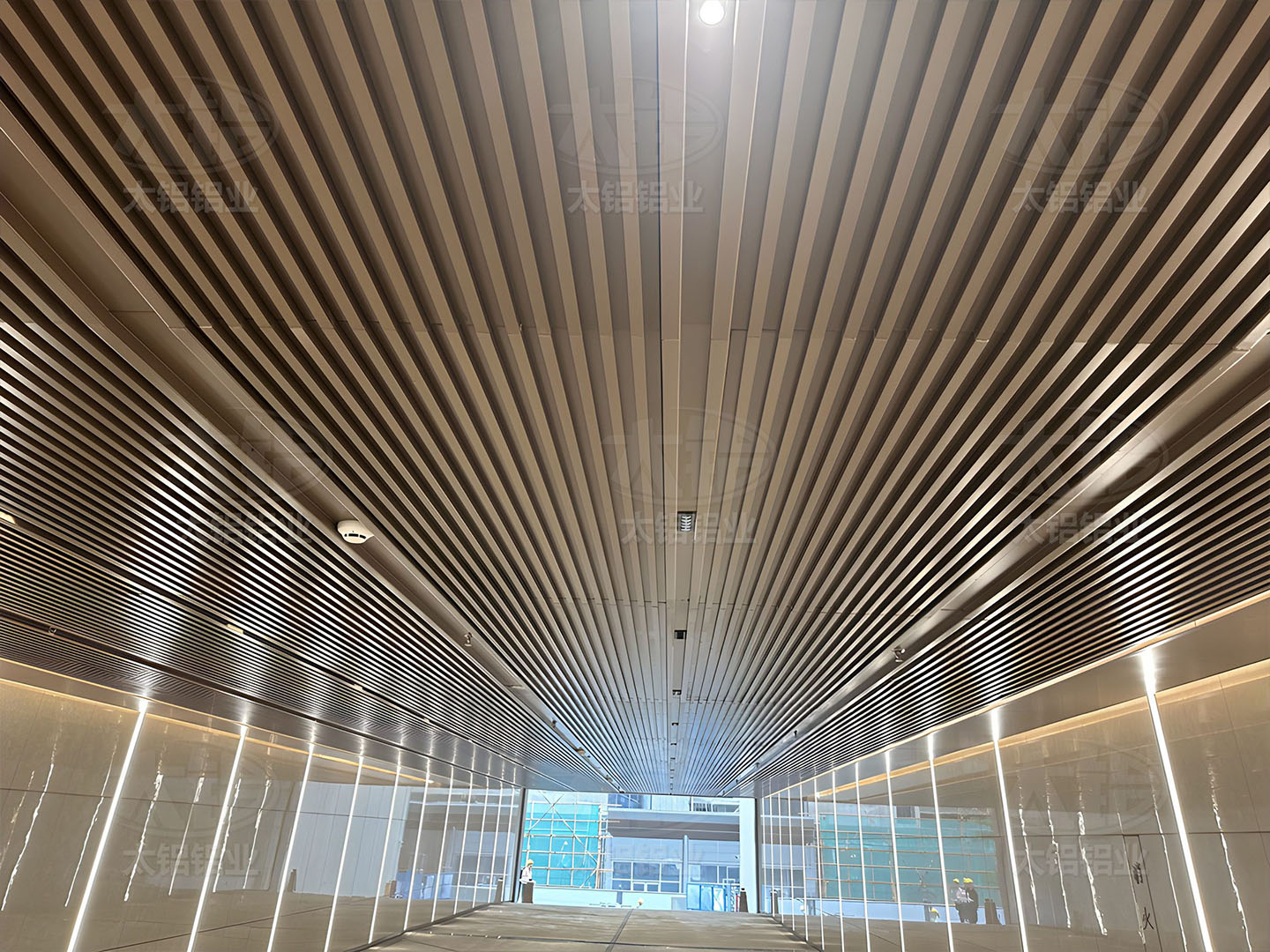
Aluminum square tube ceiling, also known as U-shaped square tube ceiling or aluminum square tube ceiling, is a translucent strip ceiling system made of aluminum alloy plates or profiles as the base material, processed through cold bending or extrusion forming and surface finishing. It is the mainstream ceiling material of choice for modern commercial spaces and public buildings, and is extremely widely applied in shopping malls, office buildings, transportation hubs and similar settings in Guangzhou and the South China region. The product consists of strip-shaped units arranged continuously, combining a three-dimensional decorative effect with practical engineering performance. It can simultaneously meet multiple requirements including spatial design aesthetics, ventilation and heat dissipation, concealed pipework and cabling, and fire-safety inspection compliance, making it an upgraded alternative to traditional grille and gypsum board ceilings.
Core Features
Open & Three-Dimensional: Elevating Spatial Depth — The open strip structure provides both visual transparency and air circulation. With clean, flowing lines, it creates diverse styles through height variation, spacing changes, and color combinations, effectively enhancing the sense of spatial depth. It suits a wide range of design aesthetics, including modern minimalism, industrial style, and new-Chinese style.
Stable Performance: Meeting Engineering Compliance — The aluminum alloy base material features waterproofing, moisture resistance, corrosion resistance, rust prevention, and resistance to deformation. Its fire-resistance rating can reach Class A non-combustible, complying with the GB 8624-2012 fire safety standard. It releases no formaldehyde, meeting indoor environmental requirements, and can be stably applied to complex scenarios such as humid environments and high-foot-traffic areas, fitting acceptance standards for various public spaces.
Modular Installation: Easy Operation & Maintenance — Using a clip-on or screw-fixed keel system, all work is performed via dry construction, ensuring high installation efficiency. Each individual square tube can be independently removed and replaced without disrupting the overall ceiling structure, facilitating later maintenance and upgrades of overhead pipework, air conditioning, and fire-fighting equipment, significantly reducing long-term maintenance costs.
Flexible Customization: Adapting to Diverse Scenarios — Supports full-dimensional customization of specifications, wall thickness, color, and shapes. In addition to conventional straight square tubes, special profiles such as curved, wavy, and irregular cross-sections can be manufactured. Surfaces can be finished in wood grain, stone grain, solid colors, and more, adapting to complex design requirements for interior ceilings, exterior curtain walls, and entrance grilles.
Common Classifications
By Forming Process
U-Shaped Aluminum Plate Square Tube (Cold-Bent Type): Formed from aluminum plates through continuous roll forming / one-piece cold bending, with a U-shaped groove cross-section. Lightweight and cost-effective, it is installed with a dedicated clip-on keel system and is the most commonly used category for interior ceilings.
Profile Aluminum Square Tube (Extruded Type): Formed from aluminum billets through high-temperature extrusion, mostly featuring closed rectangular cross-sections. It offers uniform wall thickness, high structural strength, and excellent straightness, with stronger load-bearing and wind resistance—suitable for large-span spaces, outdoor curtain walls, and ceiling applications.
Decorative Aluminum Square Tube: Produced through secondary processing of straight square tubes, such as stretch bending and welding, including curved, wavy, and gradient cross-section styles. Commonly used in distinctive commercial spaces, art venues, and other customized design scenarios.
By Surface Finish — Common finishes include polyester baking paint (powder coating), fluorocarbon spraying, wood grain transfer printing, and anodizing. Among these, the wood grain transfer print offers highly realistic texture and is the core "aluminum-substituting-for-wood" category; the fluorocarbon sprayed finish delivers outstanding weather resistance, withstanding outdoor UV exposure and corrosive environments.
Installation System Components
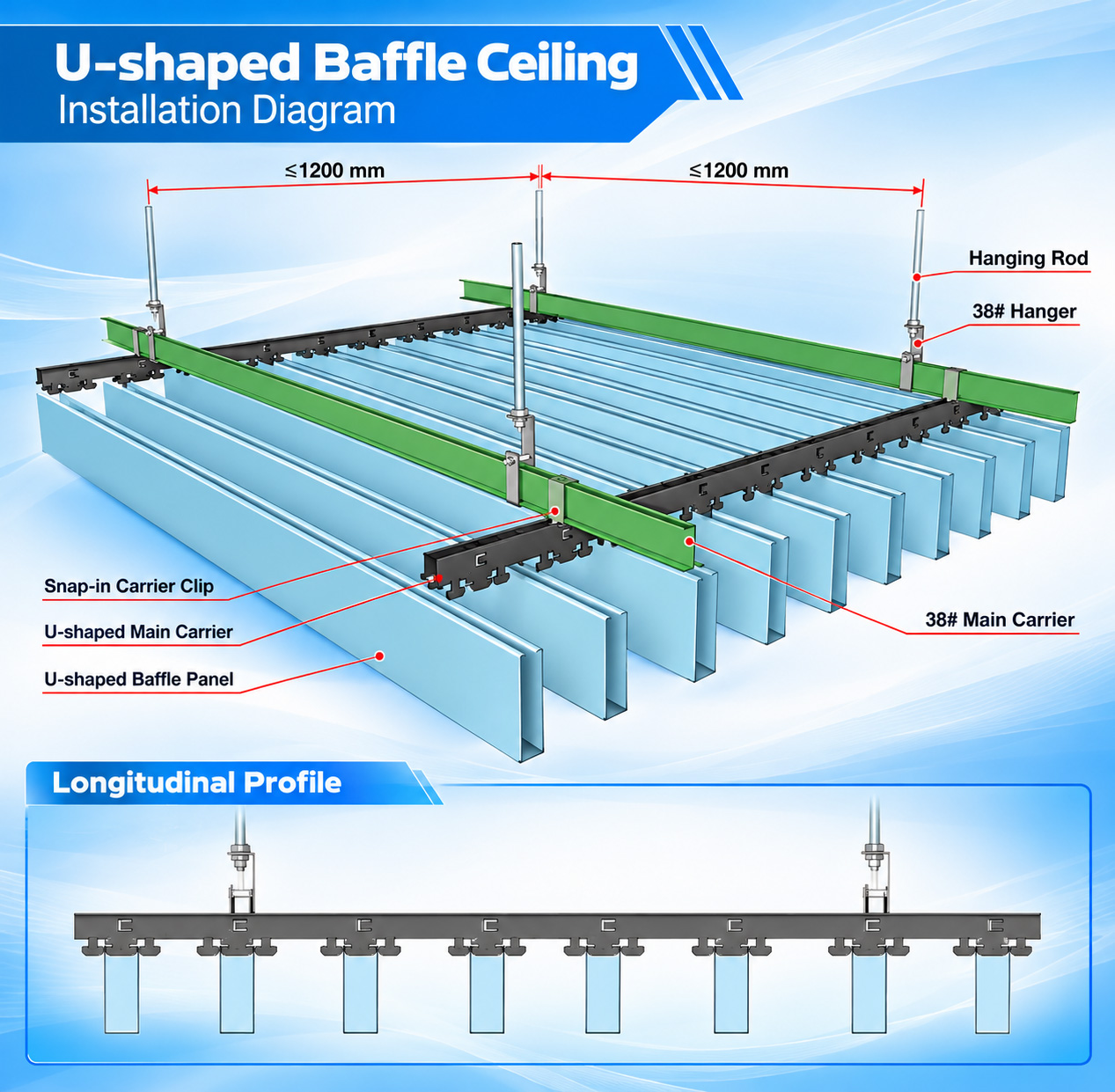
A standard aluminum square tube ceiling system consists of three parts: hanger rods (suspension wires), a dedicated keel (rail) system, and aluminum square tube units. Accessories such as edge trim (angle lines) and anti-wind clips can be added as required:
- The hanger rods are fixed to the building's ceiling slab via expansion bolts and carry the overall load of the system;
- The keel connects the hanger rods horizontally and features integrated clips/slots for securing the square tubes. In outdoor scenarios, a thicker anti-wind keel can be selected to enhance wind resistance;
- The aluminum square tube units are directly clipped into or screw-fixed to the keel, allowing flexible adjustment of spacing and installation height to suit different design schemes.
Applicable Scenarios
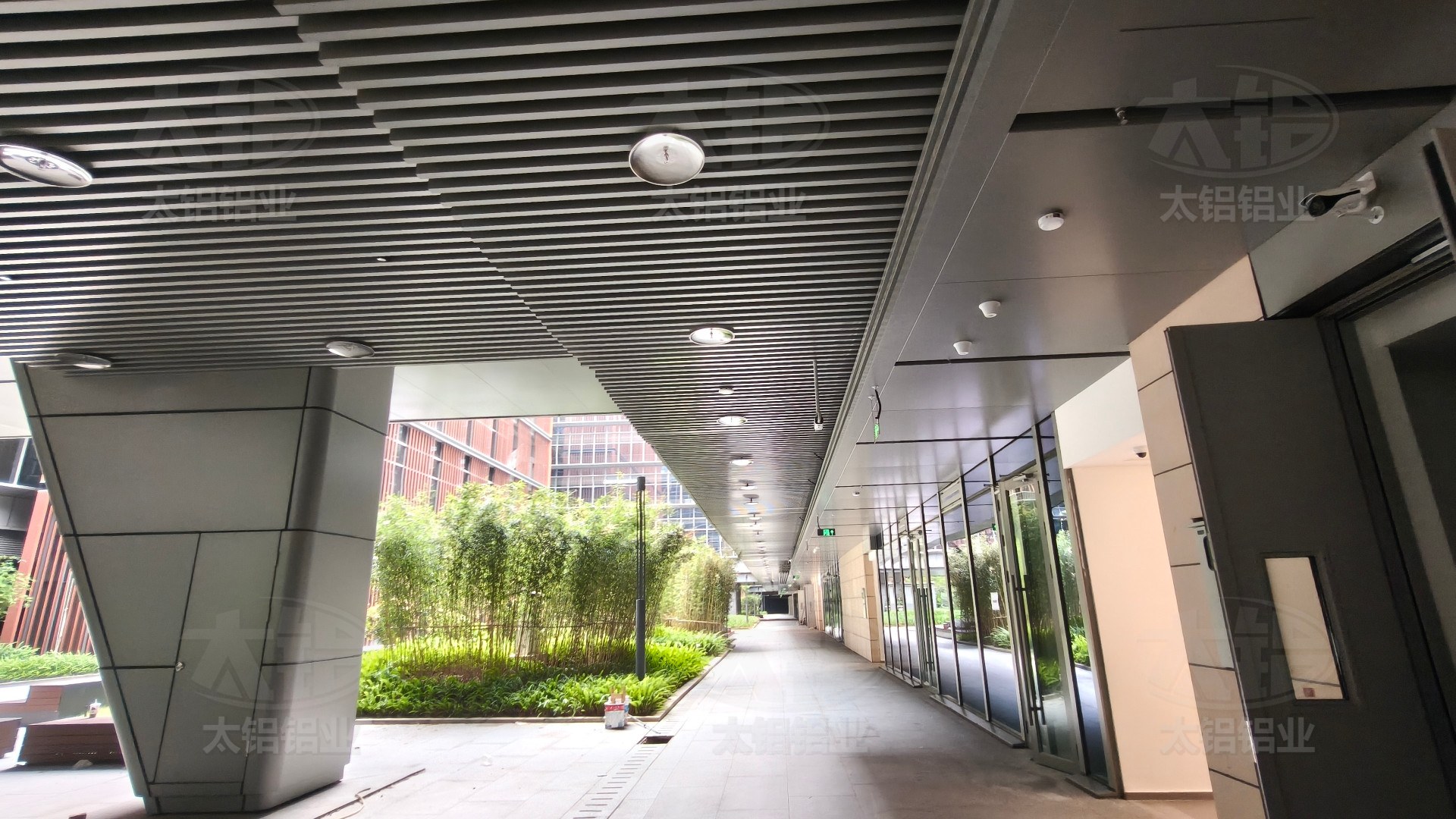
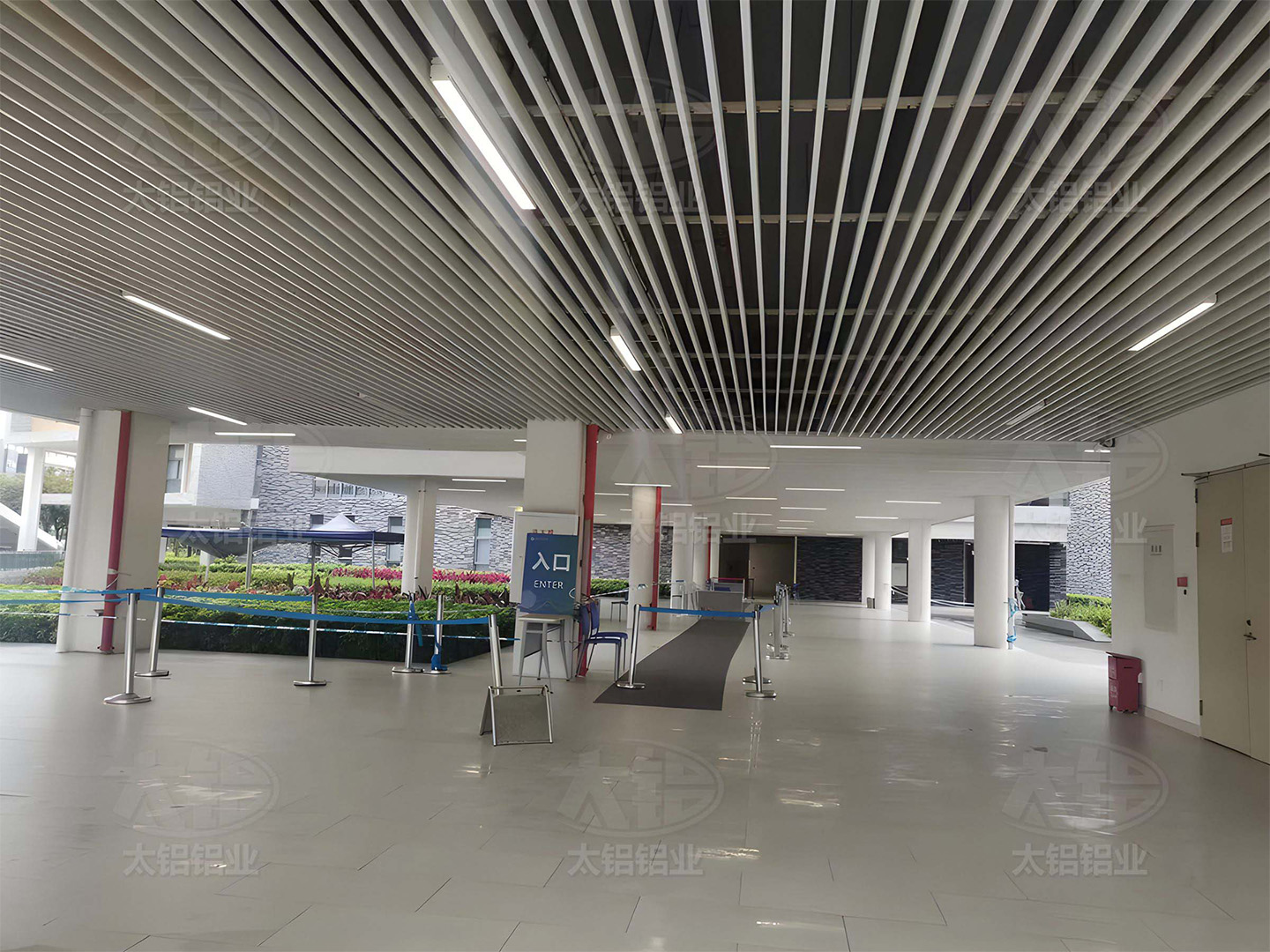
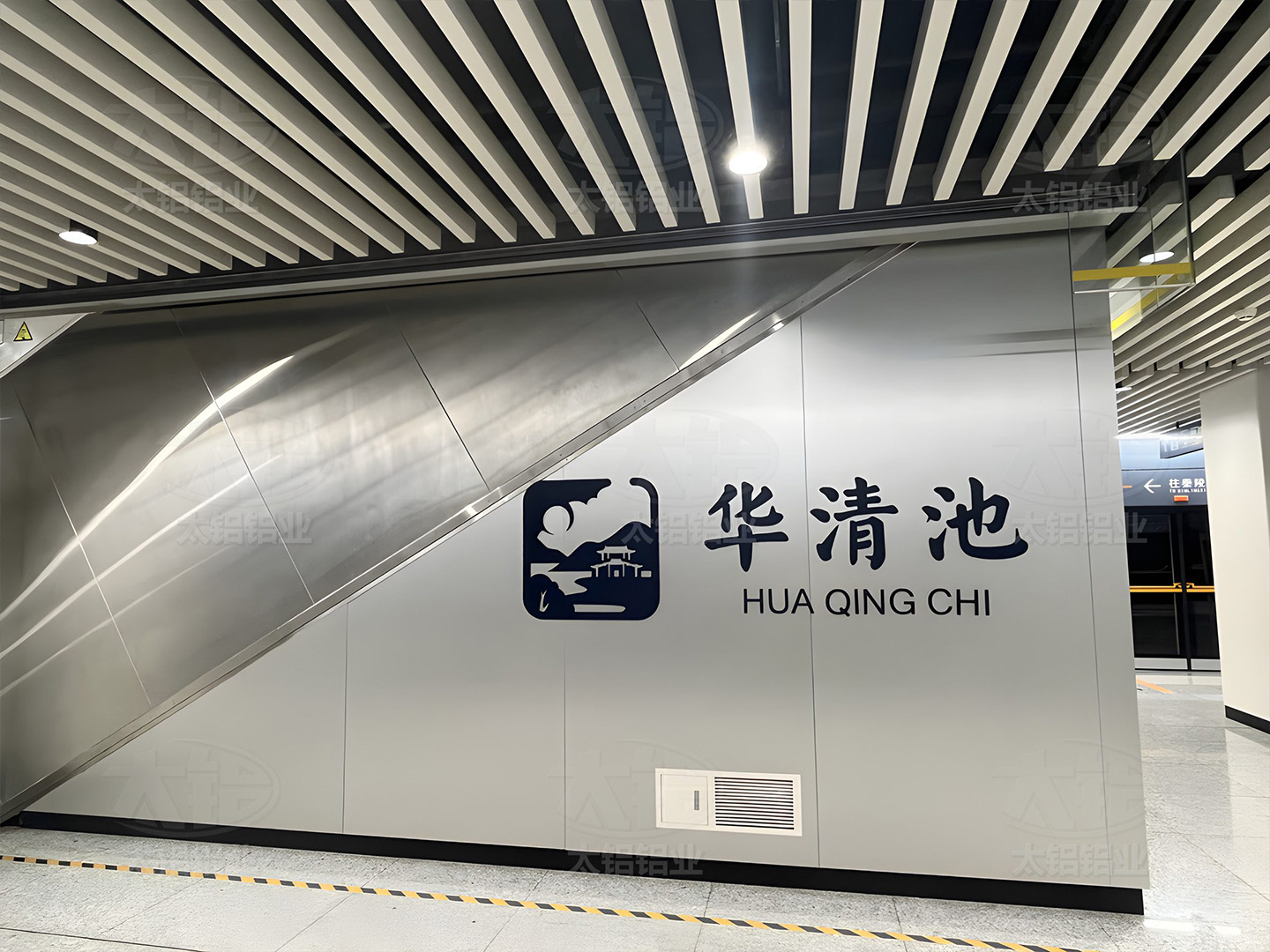
Interior Applications: Shopping mall atriums, office building corridors, airport / metro station halls, venue lobbies, hospitals and schools, restaurants and retail stores, and residential balconies / entryways.
Exterior Applications: Building entrances (storefront canopies), exterior facade grilles, sun-shading canopies, corridor ceilings (walkway covers), and outdoor rain shelters.
Frequently Asked Questions (FAQ)
1. What are the standard specifications of aluminum square tubes? How to choose the right size?
For conventional U-shaped aluminum plate square tubes, the base width typically ranges from 30–150mm, side height 50–200mm, and wall thickness 0.6–1.5mm. Profile aluminum square tubes commonly come in specifications such as 40×40mm, 50×100mm, and 100×100mm, with wall thicknesses of 1.5–4.0mm. Product length can be customized as required, with a standard maximum length of 6 meters; longer sizes can be customized for large-span applications.
Selection principle: For spaces with higher ceiling heights, choose square tubes with greater side height to enhance the three-dimensional effect; for large, open spaces, wide specifications with wide spacing are recommended to improve the sense of openness; for small spaces with low ceilings, narrower specifications with small spacing are suggested to avoid a sense of oppression.
2. How is the installation spacing of aluminum square tubes determined? Is there a standard?
There is no mandatory standard for installation spacing. It is primarily determined by decoration needs, requirements for concealing pipes and cabling, and cost budget:
- For an open, decorative effect: spacing can be set at 50–200mm to highlight the layering of lines;
- Where overhead pipes and equipment need to be concealed: a spacing smaller than the base width of the square tube is recommended, or controlled at 20–50mm, to ensure the ceiling structure is not visible from eye level;
- For general engineering applications: a spacing-to-base-width ratio of 1:1 or 1:0.5 is commonly used, balancing decoration and concealment for the best cost-effectiveness.
3. What is the difference between aluminum square tube ceilings and aluminum panel ceilings? How to choose?
The core difference between the two lies in their structural form and applicable scenarios, and they can be chosen as needed:
| Comparison Dimension | Aluminum Square Tube Ceiling | Aluminum Panel Ceiling |
|---|---|---|
| Structural Form | Bar-type open structure, strong sense of openness | Square-panel closed structure, complete ceiling surface |
| Visual Effect | Prominent linear aesthetics, enhances spatial depth | Flat and clean ceiling surface, strong overall integrity |
| Ventilation Performance | Good air circulation, conducive to equipment heat dissipation | Strong sealing, effective dust-proofing and water isolation |
| Maintenance Convenience | Individual tubes can be removed; ample space for servicing large equipment | Individual panels can be removed; relatively limited access space for pipework operations |
| Applicable Scenarios | Large public areas, corridors, entrance canopies—focused on design aesthetics |
Kitchens, bathrooms, offices, and other spaces requiring sealed, dust-proof environments |
4. How much does an aluminum square tube ceiling cost per square meter? What factors affect the cost?
The cost of aluminum square tubes varies considerably, primarily influenced by four factors: specifications, wall thickness, surface finish, and installation density:
- Standard interior U-shaped powder-coated type: approx. 80–150 RMB/㎡ (materials and labor included);
- Wood grain transfer print type: approx. 120–200 RMB/㎡ (materials and labor included);
- Profile aluminum square tubes, outdoor fluorocarbon type: approx. 150–300 RMB/㎡ (materials and labor included);
- Special shapes such as curved and wavy types: priced individually based on the design scheme, costing more than conventional straight types.
The denser the arrangement, the thicker the wall, and the more premium the finish, the higher the cost per square meter.
5. Can aluminum square tube ceilings conceal pipes and cabling, and accommodate lighting and fire-fighting equipment?
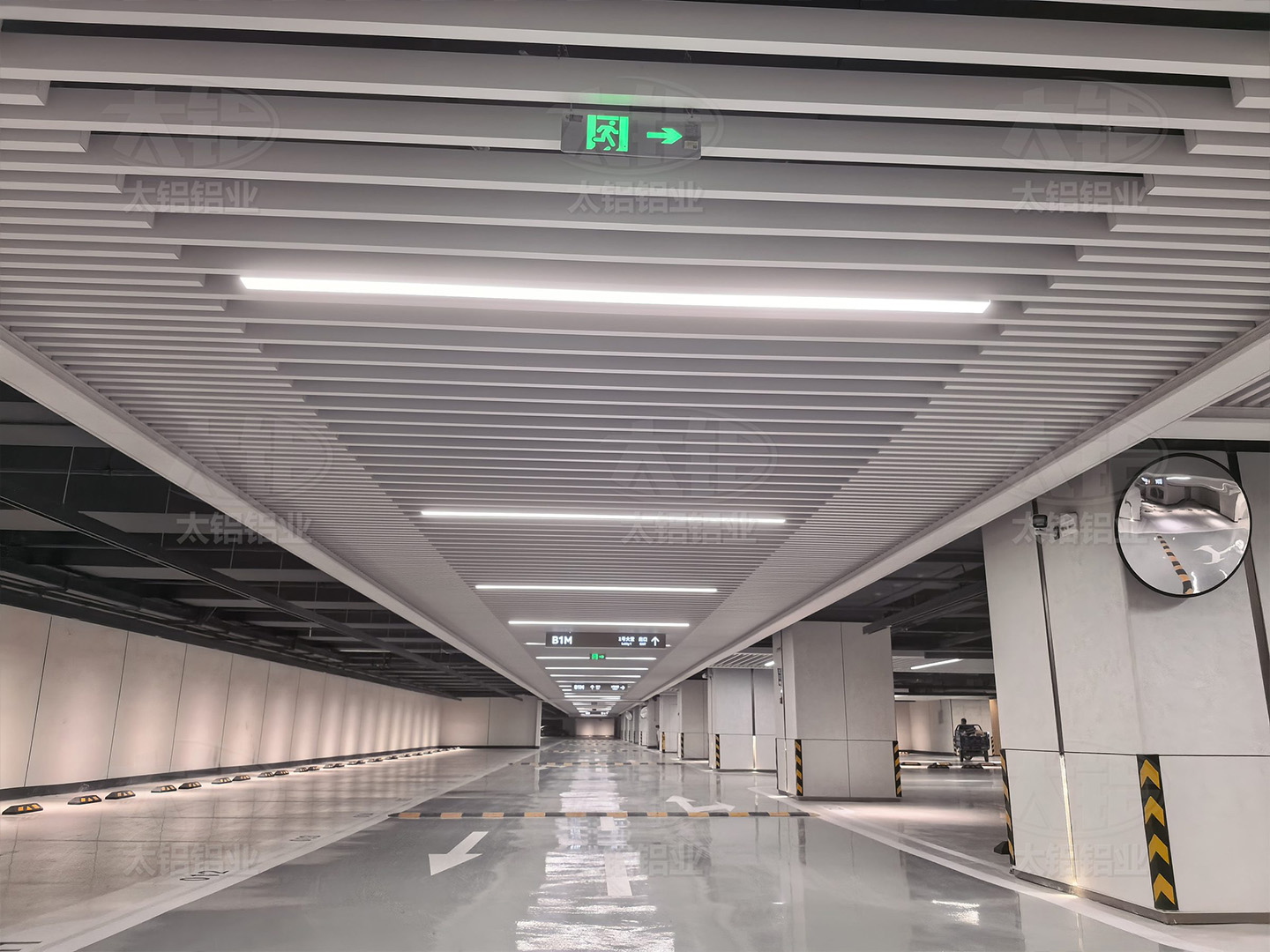
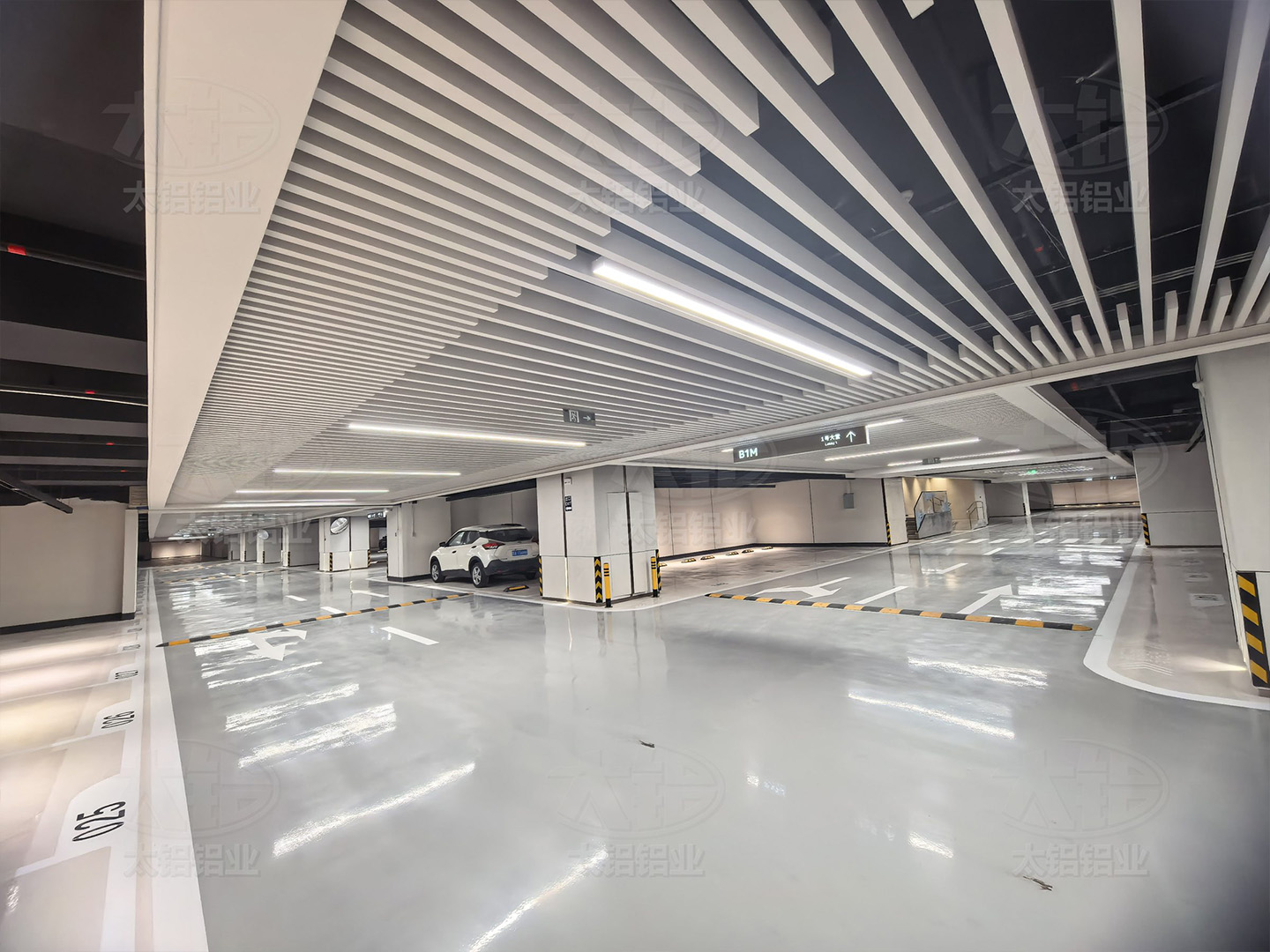
Absolutely. The open structure of aluminum square tubes allows fire sprinklers, smoke detectors, air-conditioning vents, and high/low-voltage cabling to be hidden within the ceiling, preserving a clean appearance at eye level. For lighting, dedicated LED square tube lights can be embedded, or recessed downlights and track lights can be fixed directly to the building slab or the keel, with illumination shining through the gaps between square tubes—no large-scale additional openings are required.
6. Are aluminum square tubes waterproof and fire-resistant? Can they be used in bathrooms and outdoor areas?
The aluminum alloy base material is inherently waterproof, rust-resistant, and mold-resistant, with a fire-resistance rating of up to Class A non-combustible, meeting fire-safety inspection requirements.
- For humid interior scenarios such as bathrooms and balconies: aluminum square tubes finished with polyester powder coating or anodizing can be used normally;
- For outdoor scenarios: profile aluminum square tubes with a fluorocarbon spraying finish must be used, combined with a thicker anti-wind keel, to enhance wind resistance, UV resistance, and corrosion resistance, preventing fading and deformation during long-term outdoor use.
7. Is aluminum square tube installation difficult? How long does the construction period take?
Aluminum square tubes use modular dry construction with mature techniques and low installation difficulty. The standard process is: marking and positioning → fixing hanger rods → installing and leveling the keel → clipping in the square tubes → fine-tuning and inspection. For a typical interior space within 100㎡, 2–3 skilled workers can complete the installation in 1–2 days; for large projects, multiple crews can work in a flow-line manner, achieving far higher construction efficiency than traditional ceilings such as gypsum board and mineral fiber board. It is ready for immediate use with no curing period.
8. How should aluminum square tubes be cleaned and maintained? What is the normal service life?
Daily maintenance is simple: surface dust can be removed with a feather duster or dry soft cloth. For heavier dust or stains, wipe with a soft cloth dampened with a diluted neutral cleaner, then rinse with clean water. Do not use steel wool or strong acid/alkali cleaners, which can scratch or corrode the surface coating. Under normal indoor conditions, high-quality aluminum square tubes can last 15–20 years; outdoor fluorocarbon-coated types can be used for 10+ years under normal weather conditions without needing renovation or replacement—only periodic cleaning is required.
9. Will wood grain aluminum square tubes fade? What advantages do they have over solid wood ceilings?
High-quality thermally transferred wood grain aluminum square tubes show no obvious fading after 5–8 years of normal indoor use; outdoor weather-resistant wood grain types have stronger UV resistance and a longer service life. Compared with solid wood ceilings, aluminum square tubes offer significant advantages: waterproof, moisture-proof, and mold-free; Class A fire resistance for greater safety; lighter weight that reduces building load; no need for periodic repainting or maintenance; and lower overall usage costs—making them a cost-effective alternative for wood-textured ceilings in commercial spaces.
10. Can aluminum square tubes only be installed as flat, straight ceilings? Can they be shaped?
They are not limited to flat, straight arrangements—the structural form is highly versatile. Besides conventional horizontal straight rows, step-like layering can be created through staggered heights; curved and wavy aluminum square tubes can be customized for curved ceilings; and square tubes of different colors and specifications can be combined to achieve gradient effects, mosaic patterns, and other rich design results, meeting various personalized spatial design requirements.