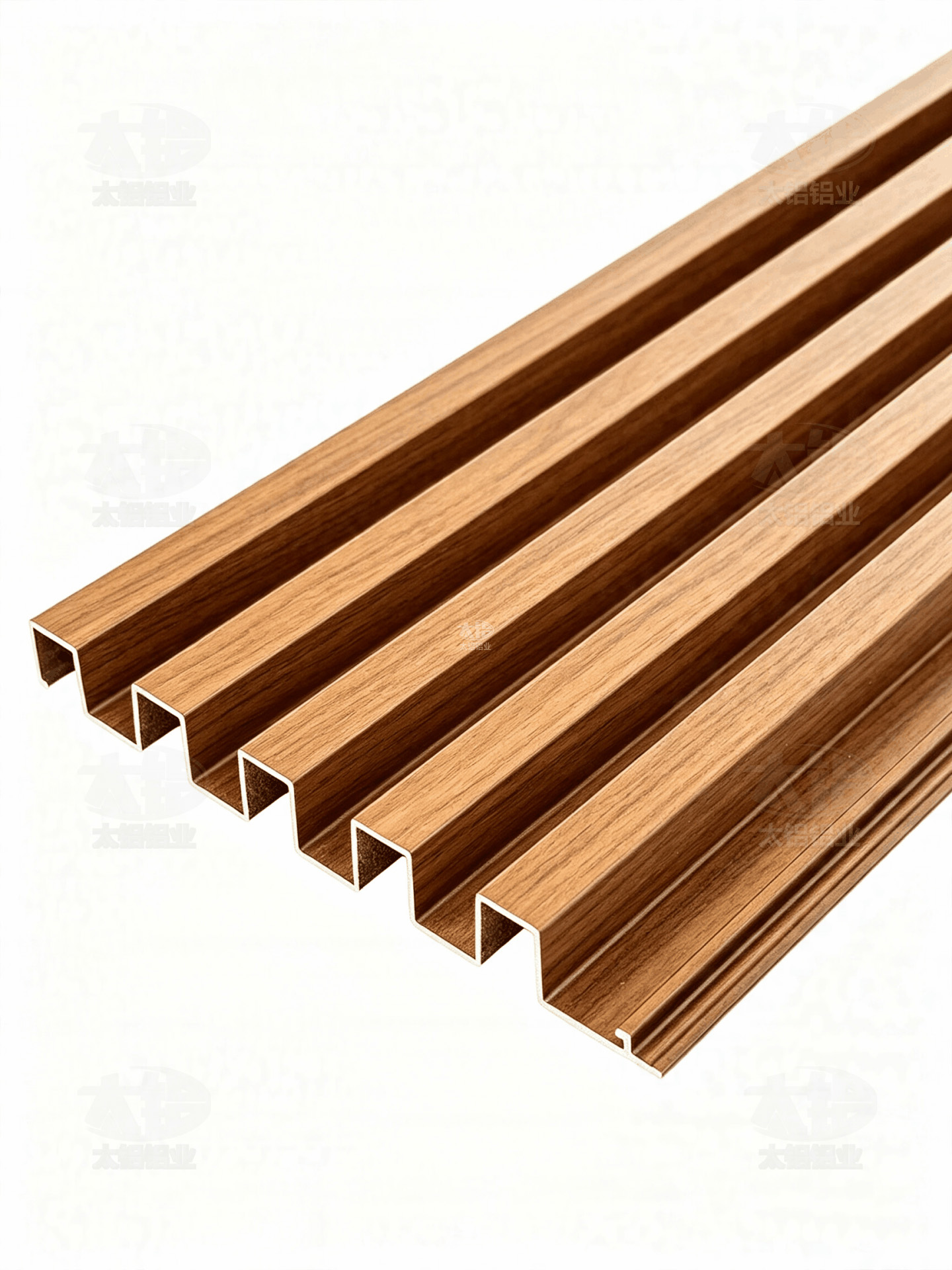
Corrugated profile aluminum veneer, commonly known as Great Wall aluminum veneer, concave-convex aluminum veneer or Great Wall panel aluminum veneer, is named after its staggered concave-convex cross-section resembling the battlements of the Great Wall. It is a highly decorative shaped metal cladding material for architectural decoration.
Manufactured in strict accordance with GB/T 23443-2024 Aluminum Veneers for Architectural Decorations, the product takes aluminum alloy as the base material. It can be integrally formed by CNC bending & welding or profile extrusion. The surface can be finished with spraying, wood grain thermal transfer and other treatments. It is installed with a matching clip-on dry-hanging system. Featuring natural three-dimensional texture and light & shadow layers, it is an upgraded eco-friendly building material to replace wooden Great Wall panels, PVC Great Wall panels and stone feature walls.
As a typical metal decorative product for "aluminum instead of wood", corrugated profile aluminum veneer retains the well-arranged three-dimensional decorative effect of Great Wall panels. Meanwhile, it inherits core advantages of metal materials including Class A fire resistance, waterproof & moisture-proof performance, low deformation rate and long service life. It is widely used for feature walls in commercial spaces, building door headers, shaped curtain walls, indoor ceilings and other projects in Guangzhou and South China. It fits various decoration styles such as modern, new Chinese, light luxury and industrial styles.
Core Advantages
- Concave-convex 3D profile with strong decorative layering The staggered corrugated texture naturally creates light and shadow effects, delivering stronger design sense and visual impact than flat aluminum veneers, with smooth and regular lines. Different texture effects can be achieved by adjusting the concave-convex height and spacing. The wood grain version can highly restore the warm texture of solid wood Great Wall panels while avoiding natural defects of timber, presenting uniform and neat effects for large-area installation.
- Integrated reinforced structure, high flatness and low deformation risk The concave-convex profile forms multiple integrated reinforcing ribs on the panel surface. Its structural rigidity is far higher than flat aluminum veneers of the same thickness. It resists deflection and deformation when installed over large areas. The panel remains flat without welding large quantities of extra reinforcing ribs, providing outstanding stability for large-span walls and ceilings.
- Full-scenario compatibility, superior performance over traditional panels The aluminum alloy substrate reaches Class A non-combustible standard, completely solving pain points of wooden and PVC Great Wall panels such as flammability, mildew caused by moisture, insect damage and deformation. The product features waterproof, moisture-proof, weather-resistant and anti-corrosion properties. It can be stably used in humid indoor spaces, outdoor door headers and curtain walls without cracking, warping or fading.
- Clip-on dry hanging system for easy installation, removal and maintenance It adopts a special keel clip-on dry hanging installation method. Single panels can be detached and replaced independently without damaging the overall structure, facilitating later maintenance of pipelines and lamps behind walls. Construction is fully dry operation, no glue or plastering required. It features high installation efficiency and can be put into use right after installation with no curing period.
- Flexible customized profiles to meet personalized design Full-dimensional customization of concave-convex height, spacing and panel width is supported. Custom special profiles include standard equal-spacing type, gradient height type, curved bent type, two-color spliced type, perforated sound-absorbing type, etc. It can be matched with lighting to create light & shadow effects and satisfy various personalized design requirements.
- Eco-friendly & easy maintenance with lower long-term cost The metal substrate is 100% recyclable with zero formaldehyde emission, complying with green building material standards. The dense surface coating is anti-fouling and easy to clean; dust and stains can be wiped off simply with a soft cloth. No regular waxing or repainting maintenance is required as for wooden panels. Its service life can exceed 20 years under normal indoor conditions, with much lower long-term cost than traditional panels.
Product Classification & Selection Guide
Classified by Forming Technology
Cold-bent & welded corrugated aluminum veneer: Formed by CNC bending and welding of aluminum sheets. The concave-convex dimension can be flexibly adjusted for non-standard height differences and special profiles. Cost-effective, widely used for indoor feature walls and non-standard shapes. Extruded profile corrugated aluminum veneer: Integrally formed by high-temperature extrusion of aluminum billets. It boasts high dimensional accuracy, tight panel joints and excellent structural strength. It shows good integrity after installation without welding traces, making it the first choice for large-scale projects and outdoor curtain walls.
Classified by Surface Finish
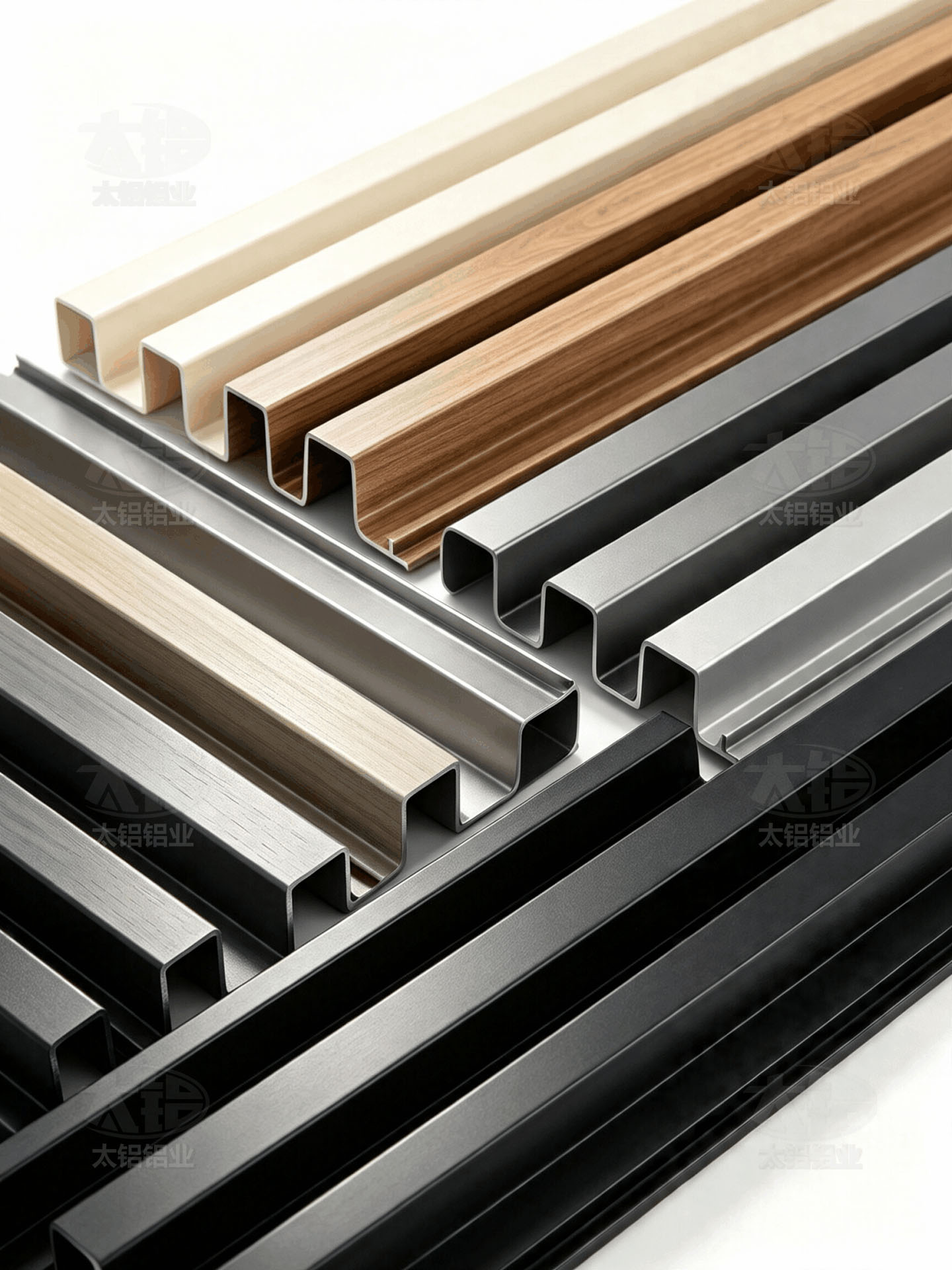
Solid color coating version: Matte/high-gloss solid color with rich and uniform colors and strong modern feel. Polyester coating is suitable for indoor walls and ceilings. Wood grain thermal transfer version: Restores natural wood textures of walnut, oak, teak and more with warm texture. It is the core alternative to solid wood Great Wall panels and currently the most widely used type. PVDF weather-resistant version: PVDF coating on the surface, complying with GB/T 23443-2024 Grade I weather resistance standard. UV-resistant, weather-proof and anti-corrosive, specially used for outdoor door headers and curtain walls. Perforated sound-absorbing version: Micro holes stamped on concave-convex panels, with sound-absorbing cotton attached on the back. It combines 3D profile with noise reduction function, suitable for spaces with acoustic requirements such as cinemas, meeting rooms and machine rooms.
Classified by Profile Style
Standard equal-spacing type: Uniform concave-convex height and spacing, neat and elegant, general-purpose for engineering projects. Gradient profile type: Gradual transition of concave-convex height and spacing for stronger design sense, mostly used for feature walls and art spaces. Curved bent type: CNC stretch-bent into arc or wave shapes, suitable for cylinders, curved walls, curved ceilings and other special shapes. Two-color split type: Separate coloring on concave and convex surfaces for strong light & shadow contrast and visual impact, often used in brand stores and internet-famous spaces.
Installation System Composition
The standard corrugated aluminum veneer system falls into two categories according to application scenarios: Ceiling / Interior Wall System: Hanger / Wall embedded parts + Main keel + Special clip keel + Corrugated aluminum veneer + Color-matched edge trim. Panels are locked to the keel via back clips, forming tight, flat joints with no exposed nail holes after installation. Outdoor Curtain Wall System: Vertical main keel + Horizontal secondary keel + Stainless steel angle bracket + Corrugated aluminum veneer + Neutral weather-resistant sealant. Panels are fastened to the keel via angle brackets, and panel joints are filled with weather sealant to guarantee waterproof and wind-resistant performance.
Application Scenarios
Commercial Spaces: Feature walls of brand stores, hotel lobbies, restaurant walls/ceilings, mall corridors, exhibition image walls, facades of chain stores. Building Facades: Shop signs, shaped building curtain walls, canopy ceilings, column cladding, corridor facades. Residential Spaces: TV background walls, sofa background walls, balcony ceilings, entrance decoration, sunroom walls. Public Buildings: Cinemas, meeting rooms, office image walls, exhibition panels, public areas of schools and hospitals.
FAQ
1. What are the advantages of corrugated aluminum veneer compared with wooden Great Wall panels and PVC Great Wall panels?
Core advantages focus on safety, durability and maintenance cost: Safety: Corrugated aluminum veneer is Class A non-combustible and meets fire acceptance requirements. Wooden and PVC panels are flammable with high fire risks and cannot be adopted in most public spaces. Durability: Aluminum veneer is waterproof & moisture-proof, free of mildew, insect infestation, deformation and cracking, available for humid rooms and outdoors. Wooden panels tend to mildew and deform when damp; PVC panels age and turn brittle under high temperature, with a normal service life of only 3–5 years. Maintenance cost: The surface of aluminum veneer is anti-fouling and easy to clean, requiring no regular waxing or repainting. Wooden panels need annual maintenance with higher long-term cost.
2. How to select the concave-convex height of corrugated aluminum veneer?
Selection is mainly based on application scenario and floor height: Indoor ceiling & small-space feature wall: Low concave-convex version of 15–25mm with moderate three-dimensional effect without depressing the space. Indoor wall & ordinary feature wall: Medium concave-convex version of 25–40mm with balanced texture and space proportion. Outdoor door header, large-space curtain wall & image wall: High concave-convex version above 40mm with strong three-dimensional sense and visual impact.
3. Can corrugated aluminum veneer be used outdoors? How about its weather resistance?
Ordinary indoor polyester coating version is not recommended for direct outdoor use. For outdoor application, select targeted specifications: extruded profile with thickness ≥2.0mm, PVDF coating on surface, installed with curtain-wall dedicated keel and weather-resistant sealant. This configuration meets GB/T 23443-2024 Grade I weather resistance requirements. The color difference ≤3.0 after 4000h xenon lamp accelerated aging test. It will not fade obviously or deform for 10–15 years under normal outdoor environments.
4. Is the wood grain effect realistic? Will it fade?
High-quality thermal transfer wood grain version can highly restore the texture of natural timber, free of color difference and knots. The large-area laying effect is more uniform than solid wood. Under normal indoor environment, thermal transfer wood grain maintains no obvious fading for over 10 years. For outdoor application, choose PVDF weather-resistant wood grain version which passes UV aging test and guarantees over 10 years of weather resistance.
5. Will there be obvious gaps when assembling corrugated aluminum veneer? How is the overall performance?
Extruded profile version features high assembly precision, with panel gap ≤0.5mm, complying with national standard dimensional tolerance. It delivers tight joint effect; splicing traces are barely visible from a distance with excellent integrity. Cold-bent welded version can reserve natural expansion joints of 1–2mm according to design needs to accommodate thermal expansion and contraction, without affecting the overall visual effect.
6. Can special shapes such as arc and wave be customized?
Custom fabrication is supported. CNC stretch bending of profiles and bending & welding of veneers can produce special shapes including curved corrugated panels, wavy corrugated panels, tapered column cladding corrugated panels. It adapts to complex designs such as curved walls, cylinders and curved ceilings, and can realize creative shapes with staggered heights and gradual sizes.
7. What is the approximate cost per square meter?
The price is greatly affected by panel thickness, concave-convex height, surface finish and profile complexity. Reference range as follows: Indoor regular polyester coating version (including keel & installation): about USD 28–49 /㎡ Indoor thermal transfer wood grain version (including keel & installation): about USD 36–63 /㎡ Outdoor PVDF profile version (including keel & installation): about USD 49–85 /㎡ Special profiles such as curved, gradient and perforated panels are priced higher and need separate quotation according to design drawings. General rule: Higher concave-convex height, thicker panel and more complex profile mean higher cost per square meter.
8. How difficult is installation? What is the construction cycle?
It adopts standardized dry construction with mature technology and moderate difficulty. For regular wall/ceiling installation, 2–3 professional workers can finish 100㎡ within 2–3 days. Multiple teams can work simultaneously for large-scale projects. The efficiency is much higher than stone and wooden feature walls. The project can be put into use immediately after installation with no curing period for painting or plastering.
9. Can it realize sound absorption and noise reduction?
Custom sound-absorbing corrugated aluminum veneer is available. Regular micro holes are stamped on concave-convex panels, with fiberglass sound-absorbing cotton and non-woven acoustic fabric attached on the back. It can effectively absorb sound waves with Noise Reduction Coefficient (NRC) reaching above 0.6. It retains the 3D profile while realizing noise reduction, suitable for cinemas, meeting rooms, machine rooms, multi-function halls and other acoustically-demanding spaces.
10. How to clean and maintain daily? What is the service life?
Simple maintenance: Wipe surface dust with dry cloth or feather duster. For stains, dilute neutral detergent with water, wipe with soft cloth and clean with fresh water afterwards. Do not use steel wool or strong acid/alkaline detergent to avoid scratching or corroding the coating. Under normal indoor conditions, high-quality products have a service life of more than 20 years. Outdoor PVDF version can last 10–15 years under normal climate without special maintenance.