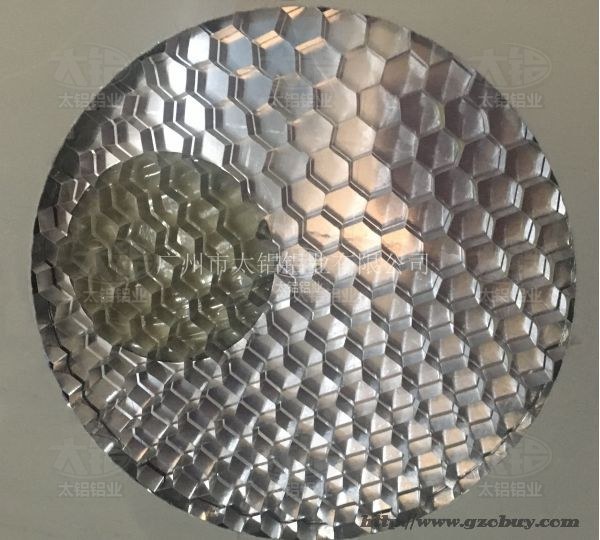
Sound-absorbing aluminum honeycomb panels, also known as perforated sound-absorbing aluminum honeycomb panels, are acoustically functional composite panels developed from the “face sheet + honeycomb core + back sheet” sandwich structure of standard aluminum honeycomb panels. The product’s face panel is manufactured using a precision CNC punching process, and the honeycomb cavities are filled with water-repellent sound-absorbing material. By leveraging the sound-absorbing structure created by microporous friction and the Helmholtz resonance within the honeycomb cavities, it achieves broad-spectrum sound absorption with a noise reduction coefficient of up to 0.9 or higher, while fully retaining the core advantages of aluminum honeycomb panels: lightweight, high strength, excellent flatness, fire resistance, and weather resistance.
As a high-end metal building material that integrates “decoration and acoustics,” acoustic aluminum honeycomb panels overcome the limitations of traditional acoustic panels—such as monotonous appearance, susceptibility to moisture and deformation, and short service life. The surface can be finished in a variety of styles, including solid colors, wood grain, and stone grain, while the perforation patterns and perforation rates can be customized as needed. These panels are widely used in spaces that demand both optimal acoustic environments and high-quality decorative finishes, such as theaters, transportation hubs, office buildings, and equipment rooms.
Acoustic Aluminum Honeycomb Panels
Core Advantages
1. Broadband Sound Absorption with Stable Acoustic Performance
Through the three-stage combination of micro-perforated panels, honeycomb cavities, and sound-absorbing materials, the panel forms a dense array of Helmholtz resonator absorption units.
This structure effectively absorbs sound waves across a broad frequency range of 100–5000 Hz, with a Noise Reduction Coefficient (NRC) of up to 0.6–0.98 in the mid-to-high frequency range. It significantly reduces reverberation time and improves speech intelligibility.
The sound-absorbing material undergoes hydrophobic treatment to prevent acoustic performance degradation caused by moisture and aging, ensuring stable long-term sound absorption.
2. Lightweight, High Strength, and Excellent Flatness Without Deformation
The panel retains the mechanical advantages of a biomimetic hexagonal honeycomb structure. With equivalent sound absorption performance, its weight is only approximately 1/2 to 1/3 that of conventional porous acoustic panels, effectively reducing structural loads on buildings.
Large-format panels require no additional reinforcing ribs, eliminating surface unevenness caused by reinforcement structures.
The panels maintain exceptional, mirror-like flatness over long-term use without warping, sagging, or deformation.
3. Non-Combustible, Clean, Safe, and Environmentally Friendly
Manufactured using aluminum alloy substrates and inorganic sound-absorbing materials, the panels achieve a Class A non-combustible fire rating, meeting fire safety requirements for public buildings such as theaters, transportation hubs, and equipment rooms.
The acoustic insulation material is edge-sealed to prevent fiber and dust shedding. It is non-toxic, odorless, and formaldehyde-free, providing excellent cleanliness.
The panels are suitable for hospitals, cleanrooms, laboratories, and other environments with strict cleanliness requirements.
4. Excellent Decorative Appearance with Customizable Surface Finishes and Perforation Patterns
Unlike conventional acoustic panels with limited appearance options, acoustic aluminum honeycomb panels offer a wide variety of decorative surface finishes, including:
Perforation patterns can also be customized, including round holes, square holes, slotted perforations, gradient patterns, and artistic designs.
The perforation ratio can be precisely adjusted according to acoustic requirements, combining effective sound absorption with premium architectural aesthetics.
5. Weather-Resistant, Moisture-Proof, Durable, and Low Maintenance
Aluminum alloy panels offer excellent resistance to moisture, water, and corrosion.
Combined with hydrophobic sound-absorbing materials, they resist mold growth and performance deterioration in humid or semi-outdoor environments.
The dense surface coating is stain-resistant and easy to clean. Dust and dirt can generally be removed using a soft cloth.
Under normal indoor conditions, the expected service life can reach 15–20 years, significantly longer than conventional mineral wool, gypsum, and wooden acoustic panels.
6. Modular Installation and Convenient Maintenance
The panels are highly prefabricated in the factory and can be installed using clip-in or dry-hanging systems, improving on-site installation efficiency.
Individual panels can be independently removed and replaced, providing convenient access to concealed pipelines, electrical systems, and mechanical equipment without damaging the overall acoustic structure.
This modular design reduces long-term maintenance costs and makes the panels suitable for acoustic renovation projects in existing buildings.
Common Product Classifications
Classification by Acoustic Structure
1. Micro-Perforated Acoustic Aluminum Honeycomb Panels
Featuring hole diameters of 0.3–2 mm and a low perforation ratio, these panels achieve sound absorption through micro-perforation resonance without requiring internal acoustic wool.
Their clean, dust-free construction makes them suitable for cleanrooms, hospitals, precision laboratories, and other environments with strict cleanliness requirements.
2. Sound-Absorbing Filled Aluminum Honeycomb Panels
These panels combine conventional perforations with internal hydrophobic fiberglass acoustic wool to provide excellent broadband sound absorption.
With a high Noise Reduction Coefficient (NRC), they are a standard solution for theaters, auditoriums, conference rooms, and other architectural acoustic environments.
3. Back-Cavity Resonance Acoustic Panels
These panels retain the honeycomb cavity structure and incorporate ventilation openings in the backing panel.
Through back-cavity resonance, they enhance low-frequency sound absorption and are particularly suitable for equipment rooms, pump rooms, and other environments dominated by low- and mid-frequency noise.
Classification by Perforation Pattern
1. Standard Round Perforations
Uniformly distributed circular holes provide stable acoustic performance and a clean, professional appearance, making them suitable for general architectural applications.
2. Slotted Perforations
Elongated perforations create a strong linear visual effect while maintaining uniform sound absorption.
They are commonly used in corridors and suspended ceilings in long office spaces.
3. Decorative Perforation Patterns
Customized gradient perforations, logo-shaped holes, and artistic patterns combine acoustic functionality with decorative aesthetics.
These designs are commonly used in branded commercial spaces, cultural venues, and architectural feature walls.
Classification by Application
1. Ceiling Acoustic Panels
-
Overall thickness: 15–20 mm
-
Lightweight clip-in installation
-
Suitable for halls, conference rooms, and equipment room ceilings
2. Wall Acoustic Panels
-
Overall thickness: 20–30 mm
-
Dry-hanging installation
-
Excellent surface flatness
-
Suitable for side and rear walls in theaters, cinemas, and sports facilities
3. Equipment Room Acoustic Panels
-
Thickened acoustic insulation layers and aluminum facing sheets
-
High noise reduction performance
-
Combined sound absorption and sound insulation functions
-
Suitable for high-noise mechanical equipment environments
Installation System Components
1. Suspended Ceiling Installation System
The suspended ceiling system consists of:
-
Suspension rods
-
Main carrying channels
-
Specialized clip-in ceiling channels
-
Acoustic aluminum honeycomb panels
-
Color-matched perimeter trims
During installation, a uniform air cavity, typically 50–100 mm deep, is maintained behind the panels to improve low-frequency sound absorption.
Maintenance access openings can be incorporated without compromising the overall acoustic performance.
2. Wall Dry-Hanging Installation System
The wall installation system consists of:
-
Vertical main support channels
-
Horizontal secondary support channels
-
Stainless steel hanging brackets
-
Acoustic aluminum honeycomb panels
-
Sealing gaskets
Panel joints are sealed to minimize sound leakage and maintain the overall acoustic performance.
For outdoor or semi-outdoor applications, fluorocarbon-coated panels and neutral weather-resistant sealants are recommended to provide both weather resistance and acoustic functionality.
Applications
|
Application Category
|
Typical Applications
|
|
Cultural and Performance Venues
|
Theaters, Concert Halls, Cinemas, Broadcasting Studios, Multipurpose Halls, Recording Studios
|
|
Public Transportation Facilities
|
Airport Terminals, Metro Stations, High-Speed Railway Waiting Halls, Bus Terminals
|
|
Commercial and Office Spaces
|
Conference Rooms, Open-Plan Offices, Shopping Mall Atriums, Hotel Lobbies, Restaurants, Banquet Halls
|
|
Industrial and Technical Facilities
|
Equipment Rooms, Pump Rooms, Cleanrooms, Acoustic Laboratories, Testing Rooms
|
|
Sports and Public Facilities
|
Sports Arenas, Swimming Pools, Exhibition Centers, School Auditoriums, Libraries
|
Frequently Asked Questions (FAQ)
1. How effective are acoustic aluminum honeycomb panels at reducing noise? What NRC rating can they achieve?
The sound absorption performance varies depending on the panel structure and configuration.
Standard filled acoustic panels can achieve an NRC of 0.7–0.9, while optimized micro-perforated configurations can reach up to 0.98.
These panels effectively absorb mid-to-high frequency sound waves, significantly reducing reverberation time.
For low-frequency noise applications, back-cavity resonance designs can increase sound absorption efficiency in the 200–400 Hz frequency range to over 65%, providing broadband noise reduction.
2. How should the perforation ratio be selected? Does a higher perforation ratio always provide better sound absorption?
A higher perforation ratio does not necessarily mean better acoustic performance. The appropriate configuration depends on the dominant noise frequencies and application requirements.
-
High-frequency speech and equipment noise: A perforation ratio of 15%–25% with hole diameters of 2–3 mm is recommended for optimal mid-to-high frequency absorption.
-
Low-frequency equipment vibration and reverberation: A lower perforation ratio of 8%–15% with micro-perforations of 0.5–1 mm, combined with a rear air cavity, is recommended.
-
General offices and transportation facilities: A perforation ratio of approximately 20% provides a balance between broadband sound absorption and decorative appearance.
3. What are the advantages of acoustic aluminum honeycomb panels compared with mineral wool and wooden acoustic panels?
The main advantages are durability, fire safety, and decorative flexibility.
Fire Safety: Aluminum honeycomb acoustic panels can achieve a Class A non-combustible rating, while many conventional mineral wool and wooden acoustic panels have lower fire classifications, potentially limiting their use in certain public buildings.
Moisture Resistance: Aluminum substrates resist mold, deformation, and insect damage, making them suitable for humid environments. Conventional wooden and mineral wool panels may deform or deteriorate when exposed to moisture.
Service Life: Aluminum honeycomb panels can last 15–20 years, while conventional acoustic panels may require replacement after approximately 3–5 years.
Decorative Flexibility: Aluminum honeycomb panels support a wider variety of surface finishes and customized perforation patterns, offering a premium architectural appearance.
4. Will the acoustic wool inside the panels release dust or fibers? Can the panels be used in cleanrooms?
High-quality acoustic aluminum honeycomb panels use edge-sealed and encapsulated acoustic insulation materials.
High-density hydrophobic fiberglass wool is treated to prevent fiber and dust shedding during normal use.
Micro-perforated panels do not require internal acoustic wool, eliminating the risk of dust release from acoustic insulation materials.
These configurations are suitable for cleanrooms, hospital operating rooms, precision laboratories, and other environments requiring high cleanliness standards.
5. Does the rear air cavity affect sound absorption performance? What cavity depth is recommended?
Yes. The depth of the rear air cavity significantly influences low-frequency sound absorption.
A properly designed air cavity can improve acoustic performance at lower frequencies.
-
Standard ceiling and wall installations: A rear air cavity of 50–100 mm is recommended.
-
Equipment rooms with strong low-frequency noise: A cavity depth of 100–200 mm can be used together with low-perforation-ratio panels to enhance low-frequency absorption.
An excessively shallow cavity may reduce low-frequency absorption, while an unnecessarily deep cavity may provide limited additional improvement and increase installation costs.
6. Will wood grain or stone grain finishes affect the sound absorption performance?
No significant impact is expected when the surface finishing process is properly controlled.
Wood grain and stone grain finishes are applied through decorative transfer coating processes without blocking the perforations or changing their designed dimensions.
The coating thickness is carefully controlled to keep the perforation walls smooth and unobstructed.
As a result, the acoustic performance remains comparable to that of standard solid-color panels.
7. Can acoustic aluminum honeycomb panels be installed outdoors? Will rain affect their performance?
These panels can be used in selected semi-outdoor or sheltered environments with appropriate configurations.
Recommended components include:
-
Fluorocarbon-coated aluminum facing sheets
-
Hydrophobic acoustic insulation materials
-
Waterproof backing panels
-
Weather-resistant sealants for panel joints
These features improve resistance to rainwater and ultraviolet exposure.
However, fully exposed outdoor environments with direct and prolonged rainfall are generally not recommended.
Long-term water accumulation may saturate the acoustic insulation material and reduce sound absorption performance.
8. Will the perforations become blocked over time? How should the panels be cleaned?
Under normal indoor conditions, dust accumulation is relatively slow, and the perforations are unlikely to become blocked quickly.
Routine cleaning methods include:
After cleaning and drying, the panels can recover their normal acoustic performance.
For high-dust environments, cleaning every 6–12 months is recommended to prevent excessive dust accumulation from affecting the perforations and acoustic performance.
9. What is the approximate price per square meter of acoustic aluminum honeycomb panels?
Pricing depends on panel thickness, aluminum facing thickness, perforation configuration, and surface finishing requirements.
|
Product Type
|
Reference Price (RMB/m²)
|
|
Standard 15–20 mm Polyester-Coated Panels
|
¥300–500
|
|
Wood Grain / Stone Grain Finish Panels
|
¥380–600
|
|
Thickened High-Performance Acoustic Panels for Equipment Rooms
|
¥500–800
|
|
Micro-Perforated Cleanroom Panels / Custom Decorative Patterns
|
Quotation Based on Specifications
|
Although the initial cost is higher than that of conventional acoustic panels, the service life can be approximately 3–5 times longer, providing better long-term cost efficiency.
10. Can special perforation patterns and decorative designs be customized? Will customization affect acoustic performance?
Yes. A wide variety of perforation patterns and decorative designs can be customized, including:
Before production, acoustic simulation can be performed to optimize the perforation parameters according to the required sound absorption performance.
This helps maintain the intended acoustic performance while achieving the desired visual appearance.
Customized perforation designs can therefore combine architectural aesthetics with effective sound absorption.